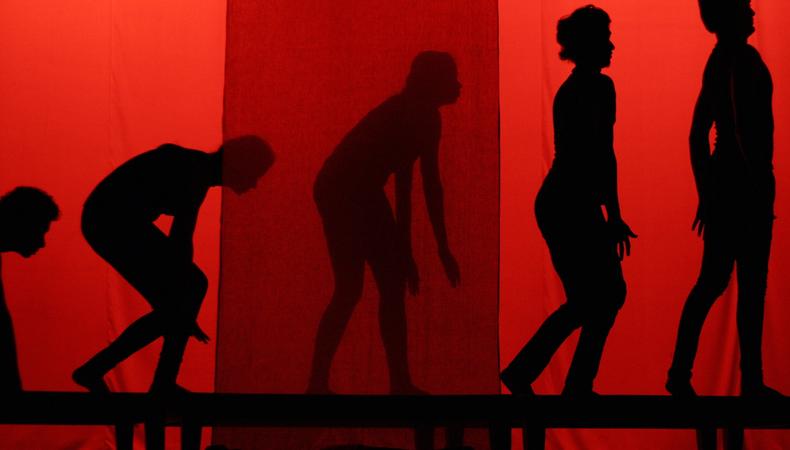
Theatre that prioritises movement, body language, or visual storytelling over something more script-centric is often called physical theatre. From mime and dance theatre to clowning and puppetry, physical theatre comes in many forms. It often includes sounds and scripted (or improvised) words, but the body – how it moves and interacts with its surroundings – takes centre stage.
JUMP TO
The history of physical theatre is as old as theatre itself. It was popular among the ancient Greeks, who used masks and physicality in their plays. A Greek chorus, for example, would use dance and song to comment on a play’s action. In the Middle Ages, mystery plays used physical storytelling to communicate meaning and plot to a largely illiterate audience.
Physical theatre has found a home all round the world, with Japanese Noh theatre, Indian Koodiyattam, Inuit drum dancing, and many other forms all drawing on the expressive capabilities of the body to get around the limitations of spoken language.
In 16th century Italy, commedia dell’arte lampooned authority figures through a cocktail of stock characters, slapstick humour, and exaggerated gestures. Because the actors all wore masks, they relied on physical expression to communicate their points. That form of physical theatre caught on in England, where it became known as harlequinades, and it’s out of that tradition that pantomime emerged. Although modern pantomimes vary in physicality, the clue to their origin is in the “mime” part of their name. Many still incorporate dance, exaggerated gestures, and slapstick humour.
Commedia dell’arte also used a type of language, later called “grammelot” (verbal gibberish), to accompany its physicality. It sounded unfamiliar and foreign to anyone who heard it, and in removing verbal exposition from the actor’s repertoire, it forced performers to convey emotions and meaning through intonation and more physical forms of expression.
In the 20th century, a new form of physical theatre emerged, championed and developed by figures such as Jacques Lecoq and Étienne Decroux, who believed the body should be the primary tool for expression rather than the text.
Physicality has some advantages over verbal expression. Here’s why many theatre practitioners choose to incorporate – or even lead with – it.
1. Expressing emotions beyond words
There’s no doubt that the emotional pull of many of our greatest stories lies in the words of their scripts – from Juliet pondering “What’s in a name?” to Thelma’s “Let’s keep goin’,” while her and Louise’s car is facing a cliff – but words can sometimes be as limiting as they are expressive. An audience has to understand not only the language in which they are spoken, but also the meaning and nuance of the specific words used.
Audiences must also be able to hear the words and associate them with what they’re watching. Speaking in clichés, for instance, won’t cut it with a savvy crowd.
2. Creating visually dynamic storytelling
The more physical a production is, the more dynamic its storytelling tends to be – and that makes for a visually engaging spectacle. The St. Crispin’s Day Speech from Henry V could be dull if it’s delivered standing still. But if you put Henry on a horse, have him raise his sword aloft or beat his breast at appropriate moments, and have a mass of downcast Englishmen appear increasingly uplifted throughout his speech, then you have a moving, rousing scene.
3. Expanding linear storytelling and breaking conventions
Theatre has long prided itself on being a radical art form. From Bertolt Brecht’s epic theatre to Augusto Boal’s theatre of the oppressed, the breaking of convention on stage is almost a convention itself. Physical theatre lends itself to a subversive approach in that it’s outside the conventional form of communication. Although we are physical in our everyday lives, the kind of physicality brought to bear in physical theatre is often exaggerated, stylised, interpretive, and unconventional in ways that challenge an audience to think, react, or engage.
4. Provoking visceral engagement
Telling you that the majority of characters die at the end of Hamlet doesn’t have the same impact as seeing them fall to the ground. Angie tasting her friend’s menstrual blood in Top Girls provokes a visceral reaction, while simply describing it in words may not – or at least not to the same degree. Knowing that, creators use physical theatre to provoke visceral reactions in audiences in a way simple words often cannot.
Mask has been one of the most prominent physical theatre conventions at least as far back as Aeschylus. Why? Masks have an effect on both the performer and the audience. For the performer, masks force an interiority of performance. They are no longer just speaking the words in the script. They must look inwards, consider and feel their physicality, and use physical expression to convey the emotion and meaning for which they would usually rely on their face and words. (Some masked performers still use speech, of course, but limiting facial expressions still forces a greater focus on physicality.)
For the audience, the use of masks removes one of the key cues that helps us understand meaning and emotion: the performer’s face. That causes the audience to project meaning onto what they’re seeing, and to focus more on the physicality of performance. It can be either alienating or engaging, depending on the performance.
It may seem as though physical theatre has taken a fringe role in modern times, but there are some respected practitioners who have helped to keep the form current.
-
Étienne Decroux (1898–1991)
Decroux developed his own system of physical theatre techniques, called corporeal mime, and trained one of the most famous mime artists of all time, Marcel Marceau. His method was a reaction to the leaps forward in technology in lighting, sound, and staging in the 20th century that he felt had occurred at the expense of actors, who were expected only to recite their lines accurately. Decroux’s physical theatre aimed to transform and revitalise the actor’s role on stage, integrating the body into all dramatic situations.
-
Jacques Lecoq (1921–1999)
In 1956, Lecoq founded the École Internationale de Théâtre Jacques Lecoq. It became – and remains – a major centre for physical theatre training. Lecoq developed his own techniques for physical theatre, including the Five Masks, through which an actor progresses as they become more skilled at physical expression. He also developed the Seven Levels of Tension to help actors understand different states of physicality.
-
Complicité (1983–present)
Complicité was founded by four actors who had studied at the Lecoq school and wanted to bring its physical emphasis to British theatre, which they saw as restrictively text-bound. The company remains one of the most exciting in the UK today.
-
DV8 (1986–2016)
Founded by Lloyd Newson, DV8 was a British theatre group that created influential, movement-based performances exploring political and social issues. Newson’s work was influenced by Lecoq and Vsevolod Meyerhold, combining dance with narrative storytelling.
-
Frantic Assembly (1994–present)
Frantic Assembly productions use highly choreographed movement and ensemble work, drawing on Lecoq’s physical tension states.