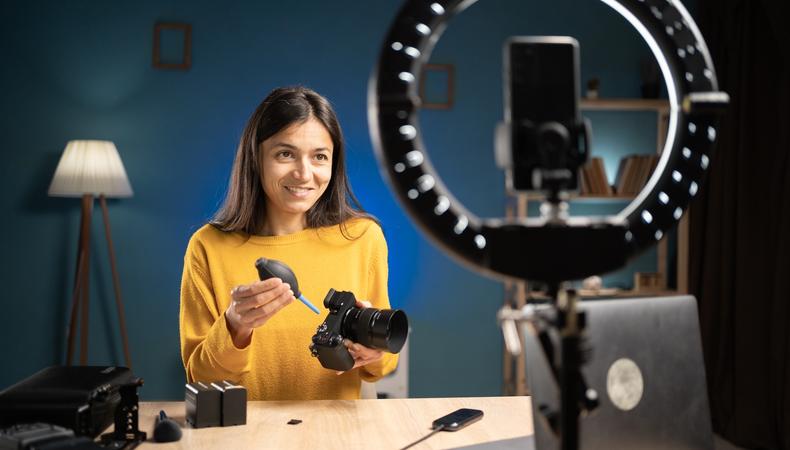
A career as a content creator may seem like a dream from the outside. You get paid to post about things you’re often genuinely interested in – sometimes without leaving the house. But how does reality compare to fantasy?
“You’re probably wondering, ‘What does a content creator do?’” says fashion and lifestyle creator Kim Ebrahimi. “‘Do they just frolic around? Are they your unemployed friend on a Tuesday? Do we work full 12-hour days?’ You’d never know because you only see a little fraction of our lives.”
Don’t get us wrong: Earning a living by creating content thousands or even millions of people consume can be incredibly rewarding. But a lot of work goes into becoming a user-generated content (UGC) creator. Want this to be your full-time job? You must treat it accordingly.
If you’re wondering how to make content creation your full-time career, read on for a peek behind the curtain at everything creators do to turn their content into a living.
1. Creating the content
Filming a video involves considerably more than simply stepping before the camera and hitting Record. Behind every post lurks a long process. You’ll have to:
Research
The ideation phase is when you research trends and brainstorm ideas to conjure up the subject of your next piece of content. Inspiration sometimes strikes out of nowhere. Other times you’ll be Googling content ideas or scrolling your feed to get the creative juices running.
Write the script
“For creators, a good YouTube script is a must,” Lydia Sweatt writes for vidIQ. “It’s your secret weapon for organising ideas, delivering a clear story, and captivating your audience.”
A structured script maximises clarity, pacing, and professionalism by eliminating filler words, hesitations, and digressions. It’s the backbone of your content – the element that turns what you’re saying into a structured presentation rather than a meandering tangent.
Outline
Once you’ve decided what you’ll be saying, you can start thinking about what you’re shooting. Some creators spend all their time speaking into the camera, but many produce and include:
- B-roll footage with voiceover
- Graphics
- Visual effects
- Footage from different locations
- Animations
- Onscreen text
Proper planning ensures that you’ll capture everything necessary during the filming process.
Film
This is the core of the creation process, and it’s probably more demanding than you’d ever expect from the other side of the screen.
Here’s everything Anna from A Plus Socials does while filming a UGC product video. She:
- Reviews the script
- Pastes speaking parts into her smartphone’s teleprompter app
- Records all speaking parts first to keep audio at the same level throughout, once as a voiceover and once while speaking on camera so she can alternate between talking head, B-roll, and green screen
- Sets up her mic and smartphone for shooting in front of a window while the light is good, and then shoots talking-head footage
- Reviews talking-head footage to make sure she got everything
- Batch records all B-roll in chronological order, using a clip-on light, key light, and projector light
- Films lifestyle footage where she’s in the frame with the product
- Revisits the script to make sure no shots are missing
And that’s for short and simple UGC.
The New Zealand YouTuber known as Internet Historian, who often takes over a year between releasing complex long-form videos, says that even the relatively basic seven-second opening shot from his ‘The Cost of Concordia’ video took 15 to 20 minutes, and that a 38-minute video could contain around 570 separate shots.
Edit
“When I am not filming, I am editing!” says YouTuber Lauren Norris. “Editing is a vital process of creating a good YouTube video, so I spend a lot of my day perfecting each clip and making sure it is high quality for all my viewers.”
Editing transforms raw footage into postable content. ThinkMedia has a great step-by-step road map to editing for YouTube in CapCut. In a nutshell, editing generally involves:
- Importing files from your camera
- Organising footage into folders
- Importing files to your editing software
- Organising footage into a rough cut
- Removing any mistakes, silences, or irrelevant info
- Adding in other visuals, such as B-roll footage, animations, or graphics
- Adding onscreen titles and captions, plus a transcript
- Adding music and other sounds
- Reviewing the final product
- Creating a thumbnail and writing a title and description
- Exporting the video to your chosen platform
2. Interacting with the community
Since every content creator needs an audience, engaging with both your followers and the general community is an absolute must. It may involve:
- Reacting and replying to comments on your posts
- Returning DMs
- Writing and sending out a weekly newsletter
- Posting more personal short-form content, such as Instagram Stories
- Contributing to a Discord server
- Browsing social platforms to stay up to date on emerging trends and note what competitors are posting
- Using community posts, Q&As, polls, and surveys to discover what kind of content your followers want to see more of
- Checking out analytics to determine how people are reacting to your content
- Reaching out to other creators in your space to arrange collaborations
3. Taking care of business
“Even though it doesn’t look like it, content creation is a business,” says “frugal chic” influencer Mia McGrath.
The business side can be as demanding as the content-creation side, which is why many established creators hire agents, accountants, and managers for assistance. Common tasks include:
- Researching and applying for content creation jobs
- Pitching to brands
- Discussing deliverables (what clients expect from you), reviewing contracts, building creative briefs, and negotiating your rates
- Participating in planning calls
- Reviewing content before posting and sending any promised deliverables
- Sending invoices
- Managing your income, working out how much to save for the taxman, and doing your accounting
Working with clients may be straightforward, but it can get very detail-oriented. Don’t assume one job will be like the next.
“Sometimes [a sponsored post] involves telling [a brand] exactly where I’ll be taking the photo or video, what outfit I’m going to be wearing in it, how much or how little makeup will be on my face, what color my nails will be, or how the product will be featured in the content,” influencer Lucie Fink told Forbes.
4. Planning ahead
Long-term planning marks out a hobbyist from a professional content creator. For it to be a career, you need to think beyond today and tomorrow. Dedicated content creators will:
- Plan out content weeks or months ahead of time and set realistic production schedules
- Review how they may need to evolve as their follower count grows
- Evaluate their current content and determine where production quality and storytelling could be improved
- Experiment with new formats and platforms
- Stay abreast of what other creators are doing and what’s happening in their niche, adjusting their own content to avoid falling behind
- Schedule time off to avoid burnout