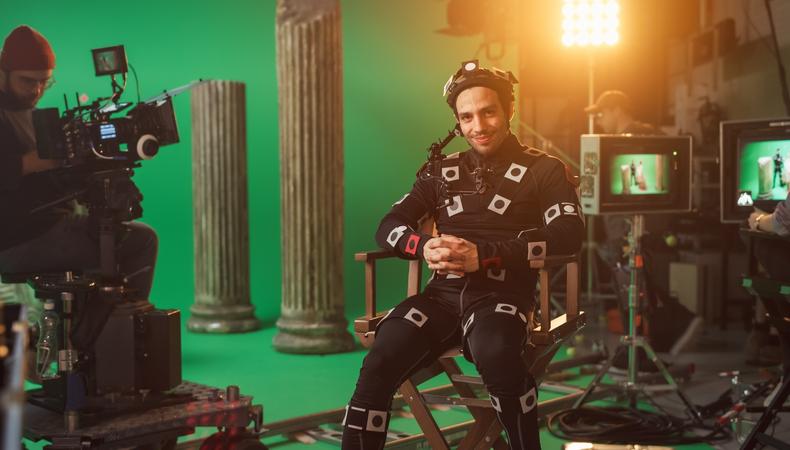
What do sympathetic aliens like the Na’vi from Avatar, brooding chimpanzees in Planet of the Apes, and brutal demigods from video games like God of War have in common? They’re all brought to life by a motion capture actor.
It’s a role that unites the skills of stage, film, and television with the imagination and physical control necessary to embody characters while wearing nothing but a skintight suit. With the motion capture industry experiencing significant growth, aspiring actors in this field are well-placed for future work.
Interested in motion capture work? Then arm yourself with an understanding of how the creative process works and how best to break into the industry as a performer.
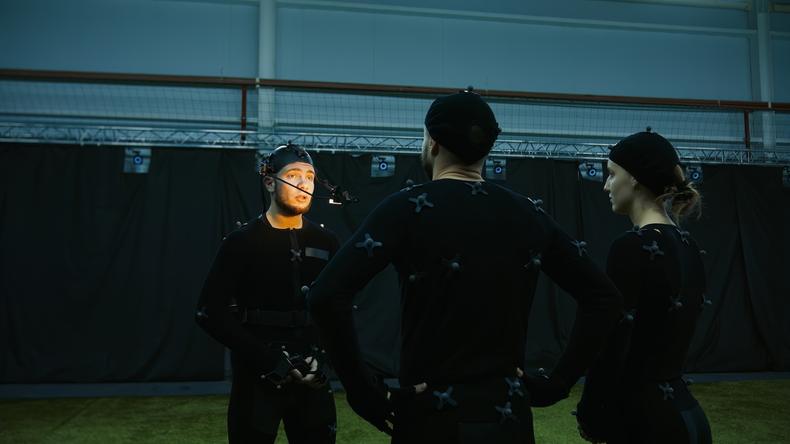
Motion capture (commonly known as “mo-cap”) involves recording an actor’s physical body using specialised cameras or sensors on a skintight suit, then translating them to a digital skeleton over which animators can overlay a digital skin or model.
You may also hear of “full performance capture.” While motion capture only tracks the body, full performance capture uses additional sensors and cameras to capture facial expressions. It’s an important distinction, but most actors interested in mo-cap will seek opportunities in both.
1. Take a short course.
Performance-based university degrees are common among motion capture actors, but not a prerequisite. However, at the least, you should take a short introductory course to pick up the basics. Plenty of studios and institutions offer mo-cap courses for newcomers. We recommend:
- Performance Captured Academy
- The Royal Central School of Speech and Drama
- London Academy of Music & Dramatic Art (LAMDA)
- Target 3D
- The Mocap Vault
For Gemma Wallace, who has secured mo-cap work for TV shows including Silo and video games like The Quarry, a short course from The Mocap Vaults helped clinch her interest and guide her understanding.
“It was firsthand viewing for me to see what it would be like on a shoot, and that was really when I was like, ‘Yes, this is something that I want to do,’” she reflects. “It really helped me understand what a production company or the studio requires the performer to do or create in that environment.”
2. Prepare your body.
The mo-cap performer’s instrument is their body – prepare to put it through its paces. Whether from unusual movements more common in animals than humans, fast-paced swordplay and stage fighting, or simply performing different movements for hours at a time, motion capture can be physically exhausting work that demands excellent body control, awareness, and fitness.
“You will have sore legs. You know, you're always kind of sore,” remarks Terry Notary, a mo-cap legend who portrayed Buck in The Call of the Wild and Groot in the Marvel Cinematic Universe. “Everybody comes off these movies super fit.”
As such, aspiring mo-cap actors are well-advised to maintain a good level of physical fitness and work on their physical awareness.
3. Consider your skill set.
Motion capture work is primarily, but not only, about acting. Here’s what Emily Dean, founder and agent at The Mocap Agency and Voice Fox, has to say about potential clients:
“First of all, I would look at someone's acting reel, can they act? Sometimes I take performers on because of a particular skill, such as I’ve got people who are amazing at parkour…. So, it is really good to look at the skills reel as well as acting reels.”
A background in dance, stage combat, gymnastics, or puppetry can boost your value, so incorporate those skills into your work, brush up if it’s been a while, and include any certifications or training when seeking jobs or representation.
Alternatively, why not acquire some new skills to stand out from the crowd? You could try:
- Stunt training from Movieworks International
- Stage combat or firearms handling from Independent Drama
Supamotionstock.com/Shutterstock
4. Research the industry.
Let’s say you’re asked to hit a “tee-pose” in the middle of the “volume” as the AD calls for a “fetch ‘n’ go.” Knowing what all that means would probably help. Start by learning the lingo, then take a deep dive into how it all works to avoid looking like a noob.
You can:
- Watch veteran mo-cap performers on YouTube. Check out popular mo-cap YouTuber Sakana in action; mo-cap veterans portraying creatures from droids to Dumbo; Andy Serkis analysing his legendary performances; or Troy Baker and Ashley Johnson creating Joel and Ellie in The Last of Us.
- Stay up-to-date on the latest tech and trends.
- Explore resources from The Mocap Vault and online guides covering the motion capture process.
T.J. Storm, whose mo-cap work includes Colossus in Deadpool and the eponymous monster in The Predator, stresses the importance of understanding what goes into the work. “We tell [aspiring mo-cap performers] how it works and why it works first off. We try to impart to them that, ‘Look, you’re making the animator’s job a lot easier. The better you are at doing that, the more often you’re going to get hired.’”
5. Build a showreel.
Like a traditional acting showreel, a mo-cap showreel assembles short clips of your best work to showcase your ability, range, and experience. You can start building one even before securing work by following these tips.
- Contact small or independent motion capture studios. Offering your services for equipment demos means they’ll get the data captured from your performance while you’ll get some footage. “It’s such a good way to start out,” says Wallace. “I’m still in contact with the companies that I put myself out there and filmed scenes with.”
- Reach out to universities. Universities offering courses in the software side of motion capture, such as Plymouth and Salford, may sometimes need actors to go through basic movements or short sequences. Ask about any opportunities to provide your services in exchange for footage.
- Take a short course. Many of the short courses mentioned above provide the opportunity to secure some test footage using the latest equipment.
Once you start gaining credits, update your showreel regularly to reflect that experience.
6. Find work.
Securing early roles often involves more time and effort than performers would prefer. Mo-cap is no different, but there are several avenues to explore.
- Contact motion capture companies. Write to UK companies (such as The Imaginarium, Audiomotion, Centroid, and Ubisoft Reflections Studios) to enquire whether they need performers and present your showreel.
- Explore job boards. Job boards are a great place to find out about live mo-cap opportunities.
- Join social media groups. Communities on LinkedIn and Facebook allow you to connect with the mo-cap industry and hear about gigs.
- Seek representation. Several agencies, such as Voicebox, Reflections, and Second Skin, specialise in motion capture work, though you can also talk to a regular agent, too, about securing mo-cap work.
- Above all, remain persistent. “Eventually I just went on LinkedIn and I just messaged all the studios, the studio’s presidents, the studio’s CEOs,” recalls Ace Ruele. “I got a reply back from a president…he passed me on to a casting director, and I auditioned for Planet of the Apes: Last Frontier. I didn’t get it, but a year later I got chosen to do the Planet of the Apes VR version from the same director. So ever since then, I've been doing motion capture.”

Kathy Hutchins/Tinseltown/Fred Duval/Shutterstock
- Benedict Cumberbatch: This well-known actor delivered an acclaimed mo-cap performance – that went viral – as Smaug the dragon in The Hobbit trilogy.
- Joseph Gatt: Gatt provided motion capture for Kratos in several God of War video games.
- Neil Newbon: Newbon is a prolific video game mo-cap performer who’s portrayed everyone from Astarion in Baldur’s Gate 3 to Karl Heisenberg in Resident Evil Village.
- Terry Notary: A mo-cap actor, stunt performer, and movement coach, Notary has mo-cap credits in the Planet of the Apes reboots, Avatar, and The Hobbit trilogy.
- Rosa Salazar: She earned acclaim for her motion capture performance in the feature film Alita: Battle Angel.
- Zoe Saldana: Saldana gave one of the film industry's pioneering mo-cap performances in Avatar and its sequel; more sequels are upcoming.
- Andy Serkis: The living mo-cap legend portrayed Gollum in The Lord of the Rings film trilogy, King Kong in the 2005 film, and Caesar in the Planet of the Apes series.