
If you’ve ever belted your heart out in the shower and suddenly hit a note that sounds like a squeak, then you may have wondered: How can I expand my vocal range? And, more importantly, can you expand your vocal range at all, or are you stuck with the one you were born with?
Good news: Although your voice has natural limits, your vocal range is far more flexible than most singers realise. With the proper training, patience, and a little vocal TLC, you absolutely can learn how to increase your vocal range and sing with more confidence and control.
Here’s a look at what vocal range actually is, what affects it, and the best ways to start broadening it.
JUMP TO
Your vocal range is simply the span of notes you can sing comfortably, from the lowest to the highest. It’s what helps define your voice type (soprano, alto, tenor, bass, and everything in between). “Your voice is unique because it comes from your anatomy,” according to music education website School of Rock. “Vocal range is the number of octaves your voice can reach.” For a full-grown man, the average vocal range is 1.5 to two octaves, while a woman can commonly reach two to three.

Credit: Nomad_Soul/Shutterstock
The short answer is yes. Your vocal cords are muscles, and, like any muscle, they respond to training. You won’t magically become a four-octave powerhouse overnight, but most singers can gain several new notes at both the top and bottom of their range with practise. “One of the biggest reasons singers take voice lessons is to learn how to expand vocal range,” according to Ramsey Voice Studio.
Improvement usually depends on vocal health, technique, age, physical development, and how you practise. (Forcing high notes is definitely not the way!)
So, yes, you can expand your vocal range, but the magic word is “method.”
Before you dive into vocal exercises, it helps to understand what shapes your voice.
Physiology
Your larynx size, vocal cord length, and resonance spaces all influence where your voice naturally sits. “Everybody’s voice is different because we have different skull size, neck length, face shape, tongue length, vocal folds length, vocal folds thickness, laryngeal agility, etc.,” singer Benny Ng writes for the website Top Singing Secrets.
Training
Untrained voices often use only a fraction of their potential. Technique unlocks access to notes that were always there, just hiding. “It takes work and dedication to nurture the necessary technical skill, stylistic flair, and vocal strength to perform,” Ahmet Ahmet writes for The Stage.
Posture
“Standing straight with your shoulders back and relaxed ensures that your lungs can expand fully, supporting sustained, clear notes,” according to the People’s Orchestra. Make sure you’re focusing on your posture when you start singing to get the best results.
Physical support and breathing
“Learning how to align and anchor the voice with the proper support helps to free up the throat and experience more sound and resonance without strain,” writes singing teacher Cari Cole. If you push from your throat rather than your stomach and don’t support your sound with proper breathing, you will damage your voice over time.
Confidence
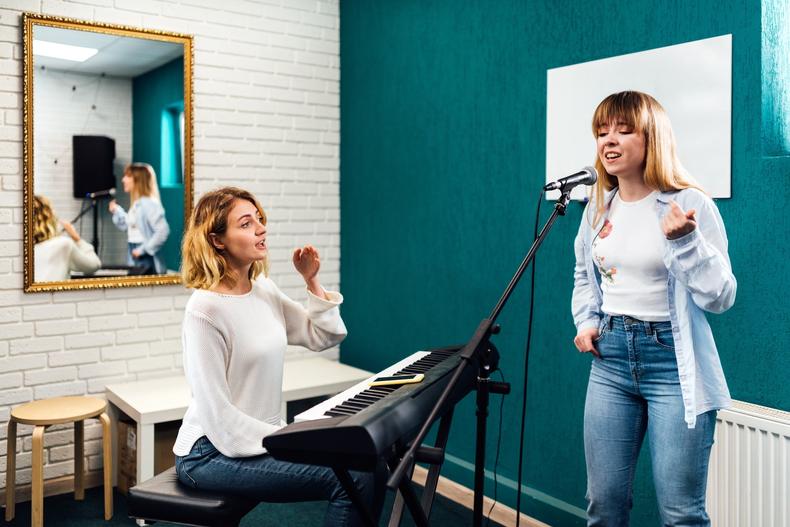
If you don’t believe you can expand your vocal range, you’re probably going to find it more difficult! It is important to have some belief in your own skills and mark any milestones along the way. “No matter where you are on your journey, you need to celebrate how far you’ve come,” Stefan Joubert writes for the London Singing Institute.
Credit: Dmytro Vietrov/Shutterstock
1. Warm up
Before you begin singing, always remember to warm up – every single time! Some exercises to try are lip trills, humming, and gentle sirens. They wake up your vocal cords without strain and prepare them to stretch, just like warming up before a workout. “With warmups designed to strengthen your vocal folds, you can be ready to sing nearly anything your heart desires with confidence,” says Grace Music Schools. “Remember: The voice is a muscle and needs proper exercise to accomplish your musical goals.”
2. Breathe
Want higher notes? Start lower in your body. Breath support is the foundation of range. Without it, reaching high notes can feel like you’re climbing a mountain. “Proper breath support is the cornerstone of successful vocal range extension,” according to the People’s Orchestra. “By engaging your diaphragm and managing breath pressure effectively, you establish a steady flow of air, which is vital when reaching for alto pitches or adding subtle semitones.”
3. Start mixing chest and head voice
Most singers hit a wall where chest voice ends and panic begins. That wall is your passaggio – the bridge between registers. Learning to mix chest and head voice is the key to broadening your vocal range without sounding strained. If you feel like you’re shouting for high notes, you’re probably doing too much. “Keep your head away from the passaggio,” the Complete Singer’s Resource advises. “Stop trying so hard to place it and stop trying to make it sound a certain way. Let it occur naturally over time and develop from your natural sound.”
4. Hydrate
Dry vocal cords mean limited flexibility. Drink water – lots of it. And avoid having caffeine and alcohol before singing. Steaming your voice has many benefits, and counts as self-care and vocal prep. “By inhaling steam, singers can directly moisturise their vocal cords, keeping them supple and ready for action,” says vocal teacher Amy Chapman. “Just like any other muscle in the body, the vocal cords need to stay well hydrated to function properly. Dry vocal cords are more prone to irritation, inflammation, and injury, which can significantly impact a singer’s ability to perform.”
“When it comes to singing, range matters,” Cole says. In other words: The broader your vocal range, the more singing opportunities you’ll be able to pursue.
What is even more critical than range, however, is how you use your voice. “Take Adele for example,” Cole continues. “One of our most famous and beloved singers today, Adele has a more limited range as a singer compared to Christina [Aguilera] or Mariah [Carey], but look at what she does with what she has.”
Remember: Expanding is about unlocking what’s already there. Whether you’re learning how to increase your vocal range for auditions or just for the fun of it, try to think of every new note as a bonus. Progress may feel slow some days, but every warm-up, mindful breath, and attempt is quietly building a stronger, more flexible voice.