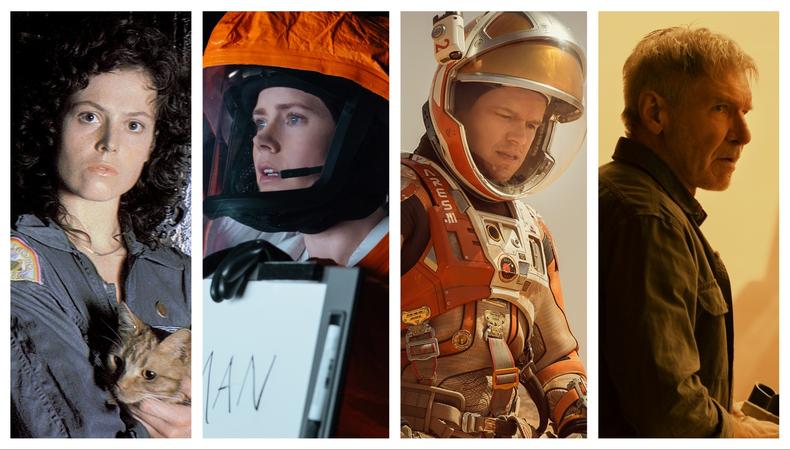
From 1902’s A Trip to the Moon to 2025’s Mickey 17, the science fiction (sci-fi) genre has imagined the future, questioned humanity’s place in it, and (perhaps most importantly) imparted a childlike sense of wonder to audiences of all ages.
“Science fiction was the first mystical experience that I had in the movies as a child,” legendary sci-fi director Steven Spielberg told TV Guide. “I think for a lot of young people, [sci-fi is something] you can’t see in your own backyard. You can only see it through someone else’s eyes.”
Spielbergian wonder aside, what truly separates sci-fi from other film and TV genres, such as fantasy and action? What makes science fiction in film and TV an enduring medium for asking big questions and imagining final frontiers?
We’re here to fill you in.
JUMP TO
Science fiction incorporates scientifically grounded concepts that don’t currently exist but could theoretically be achieved as technology advances.
“In science fiction, we’re always searching for new frontiers,” said director Ridley Scott. “We’re drawn to the unknown.”
At its core, sci-fi explores unknown futures to which science could lead us. Common concepts include:
- Time travel
- Genetic manipulation
- Alien encounters
- Intergalactic travel
- Alternate dimensions
- Artificial intelligence
Bringing such ideas to the screen has shaped landmark special effects in projects such as 2001: A Space Odyssey, Blade Runner, and The Matrix, but there’s something deeper beneath the visual spectacle of hypothetical futures. Ultimately, sci-fi may be best defined by its willingness to explore humanity, society, and existence itself.
It’s perhaps why leading sci-fi director Christopher Nolan thinks Interstellar, despite all its scientific accuracy and CGI, is really “about human beings and what it is to be human.”
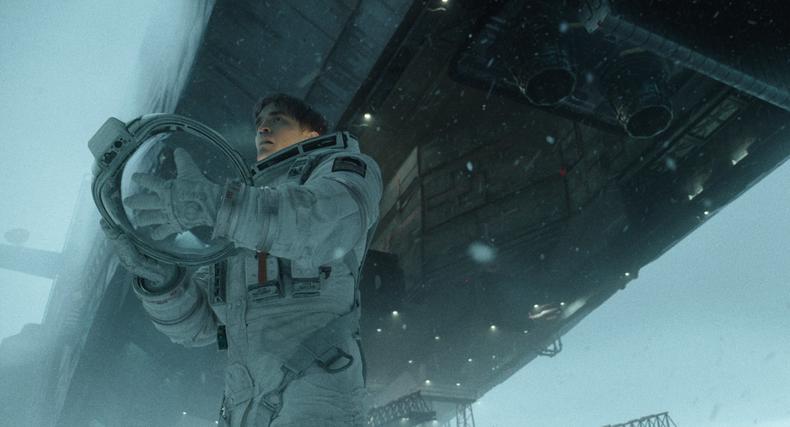
“Mickey 17” Courtesy Warner Bros. Pictures
Warnings for humanity
“Science fiction’s always been the kind of first-level alert to think about things to come,” Spielberg told the BBC. “Every science fiction movie I have ever seen, anyone that’s worth its weight in celluloid, warns us about things that ultimately come true.”
Spielberg’s filmography is replete with examples:
- Jurassic Park warns us about toying with DNA and playing god with extinct creatures.
- A.I. Artificial Intelligence explores ethical issues surrounding near-human machines.
- Minority Report examines the impact of a media-dominated world on privacy rights.
“Your scientists were so preoccupied with whether or not they could, they didn’t stop to think if they should,” the character Ian Malcolm famously noted in Jurassic Park.
Spielberg isn’t alone. Films such as Richard Fleischer’s Soylent Green, Andrew Niccol’s Gattaca, and Spike Jonze’s Her warn about overpopulation, genetic engineering, and an overreliance on AI, respectively.
Others consciously blend warnings to the present with an urging for progress. “You need to apply your passion…to that forward movement,” Saul Williams, writer and co-director of genderqueer sci-fi musical Neptune Frost, told AnOther. “As artists, the application of our craft to that forward movement manifests in films like Neptune Frost. Revolutionaries need inspiration.”
Hope for the future
Sci-fi can be both hopeful and pessimistic, sometimes envisioning a brighter future that surmounts present cultural woes and injustices.
Just look at Star Trek. Creator Gene Roddenberry famously filled it with a diverse crew of men and women to reflect a more equal society.
“I tend to think that in the future it won’t seem at all strange that women are treated as the equals of men,” Roddenberry told the Humanist in 1991. “It did not seem strange to me that I would use different races on the ship.”
The original series aired TV’s first interracial kiss just one year after the United States Supreme Court declared interracial marriage legal, while Star Trek: Deep Space Nine featured one of TV’s first same-sex kisses in 1995 and Star Trek: Discovery included a same-sex relationship.
Comparable positivity is central in For All Mankind, in which an alternate-reality space race led to everything from an earlier Civil Rights movement to controlled carbon dioxide production, and The Martian, in which several nations unite to rescue a Mars-bound Matt Damon.
Nonhuman characters
Robots, aliens, mutated creatures, and other nonhuman characters are sci-fi mainstays that may serve simply as otherworldly adversaries. The Alien franchise’s Xenomorph is a classic example.
Others reflect contemporary issues or offer an outsider perspective on humanity.
- Vogons in The Hitchhiker’s Guide to the Galaxy: Bureaucrats who demolish Earth to accommodate a new hyperspace bypass
- Cylons in Battlestar Galactica: Sentient robots who rebelled against humanity and must now grapple with their own identity
- Godzilla in Godzilla: A monster awoken by nuclear testing that embodies the fears and trauma of a nuclear holocaust
Academic Michelle N. Huang draws parallels between the ways fictional robots and Asian Americans have historically been seen. “[Sci-fi] holds up an uncanny mirror that reflects what it means to be – or not to be – human,” she says.
Scientific inspiration
“I became interested in the idea that the universe was full of intelligent civilisations, which is the current scientific belief,” director Stanley Kubrick said of 2001: A Space Odyssey.
Kubrick is one of many filmmakers influenced by contemporary scientific research. Claire Denis’ High Life came from “reading Stephen Hawking and…imagining procreation in space,” while Alex Garland’s Ex Machina sprang from contemporary AI research and a 2010 book by Murray Shanahan, a professor of cognitive robotics.
Scientists don’t just strike the initial spark – many improve the accuracy of science fiction in film and TV by serving as consultants throughout production.
- Interstellar: Nobel Prize winner and Caltech astronomer Kip Thorne offered expert guidance on the physics of black holes.
- Deep Impact: Multiple astronomers ensured the movie’s depiction of comet science would be as accurate as possible.
- The Expanse: NASA was consulted to realistically portray space travel, and astronauts coached the cast on moving accurately in zero gravity.
- Hard (The Martian, 3 Body Problem): stresses scientific accuracy and precise detail, often touching on real-world topics and making ample use of scientific consultants
- Soft (Arrival, Brave New World): explores the soft sciences, such as psychology, linguistics, and sociology, with priority given to humans and humanity rather than scientific accuracy
- Space opera (Dune, Battlestar Galactica): emphasises wonder and adventure, using space as a backdrop for epic stories of good and evil
- Cyberpunk (Alita: Battle Angel, Dredd): Combines high tech with low life in worlds where technology has advanced but society is fundamentally broken and life is generally difficult
- Dystopian (Soylent Green, The Handmaid's Tale): set in worlds defined by oppression and dehumanisation, often as a result of a natural or man-made disaster
- Afrofuturism (Brown Girl Begins, Neptune Frost): examines future themes through a Black lens and the combination of advanced technology and the African diaspora
- Apocalyptic/post-apocalyptic (War of the Worlds, Fallout): set during or after a near-complete destruction of the world as humans attempt to survive or rebuild
- Military (Starship Troopers, Red vs. Blue): depicts the military impact of sci-fi technology, typically revolving around detailed conflicts and principal characters drawn from a military organisation
- Horror (Alien, From): pits characters against the fatal consequences of scientific exploration and advancement – think murderous aliens, mad scientists, and experiments run amok