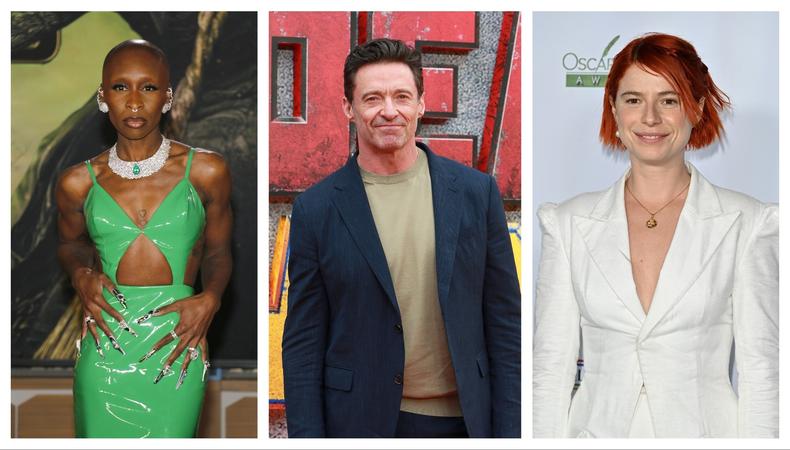
Singing on the job can be daunting for actors – even if you’re a triple-threat performer. Whether you’re auditioning for a stage musical or preparing to sing in front of a camera, a little advice can go a long way. From Wicked star Cynthia Erivo to The Greatest Showman’s Hugh Jackman, here’s what 10 aficionados have to say about singing in character.
Embrace vulnerability
Wicked star Cynthia Erivo believes: “To sing is one of the most vulnerable acts you can commit, because you are opening yourself up to judgment. I think the best of us will do it and have to tell the truth at the same time. So you’re exposing yourself in a way that you don’t necessarily have to when you speak…. I think that when you have to find someone to sing with, the reason it’s intimate is because both of you have to come together to do a vulnerable thing; and whilst you’re doing that vulnerable thing, you also have to be willing to listen and hear the other person in order to make a harmonious sound. The intimacy that is shared between two singers, when it works, is an agreement, silent or otherwise, that says: I’m going to listen to you, because I know you’re going to listen to me. There’s always a beautiful ebb and flow, like a dance. That’s really intimate to me. It’s what a relationship is.”
Allowing acting to lead your performance
Broadway and West End heavyweight Sutton Foster says, “My No. 1 piece of advice, especially for someone who’s an actor-singer-dancer… People say, ‘What’s the most important?’ I always say acting. Without knowing why you’re singing or what you’re singing about, it’s just noise. And without knowing why you’re moving your body, it’s just flailing of arms.”
Don't be afraid to take a risk
Aaron Tveit recalls his Schmigadoon! audition: “I wasn’t supposed to sing in my audition, but at the end of that first scene, I added If I Loved You [from the 1945 Rodgers and Hammerstein musical Carousel], a little snip of the song. I like to go big or go home when I audition for stuff, so that was either totally going to crash and burn, or they were gonna say, ‘No, that’s what we’re trying to do.’ Luckily for this – and I later found [this] out from [series co-creator Cinco Paul] – that’s exactly what they were trying to do. He told me that showed them that I knew what this was.”
Say yes to even the tiny stages
Singer-songwriter Sara Bareilles, who wrote the music to the Broadway musical Waitress, advises, “Get in front of people…. I was a very grassroots artist, and I toured my ass off. It was not glamorous…. But I wouldn’t trade it for anything. I learned so much about who I am. The reason I can go into these other places is because I got to know who I am on those little tiny stages in front of strangers.”
She adds, “Music, inspiration, creativity—none of it belongs to any of us. So let it be fairy dust, and honor it as such by enjoying it.”
Embrace raw hope
Wild Rose and Cabaret lead Jessie Buckley says that rewinding to the “raw hope” she felt singing songs like One Night Only and The Man That Got Away while taking part in the BBC talent contest I’d Do Anything, at age 17, is her trick for finding her singing prowess. “I get so nervous, but I also think that’s good energy. In a way, that rawness is the thing that you’re constantly trying to come back to,” she shares. “All you can do is your best; and sometimes you fall down, and that’s a very human thing to happen to you. It’s what you do on the other side of that that is the most important part and where the real growth comes.”
Learn by doing
The Greatest Showman lead Hugh Jackman admits, “I came to singing late, when I was doing Beauty and the Beast [onstage in 1996]. And in my contract, they made me have a singing lesson every week. What happened was I was learning on the job…and I kind of developed a voice that was not fully mine. [My teacher] really made me fall in love with singing.”
Take care of your voice
Actor and country music favourite Jennifer Nettles stresses good sleep: “Sleep is imperative because your instrument is a part of your body and you carry it with you wherever you go. There are pros and cons: It makes it very mobile, but it also means everything you do to your body, put in your body, or expose your body to can affect your instrument. Most specifically for me, alcohol. I can’t do it as a singer; it causes reflux and a ton of issues…. Sleep, no alcohol, warm up, cool down.”
Andra Day on accessing your character through their vices (with caution!)
United States vs. Billie Holiday star Andra Day recalls her unconventional, and not entirely advisable, route to finding Holiday’s voice: “All of this [was] pure gravel,” she told Backstage, pointing to her throat and chest. “I stopped taking care of my voice. No more tea, no more honey, no more lemon...just ice cold, yelling, no scarves, no warmth, you know, not taking care of myself!” While she does not recommend this approach to other performers – after all, it pretty much negates all tips for protecting your voice – she believes it was key to accessing Holiday’s subconscious thoughts and emotions.
“To me, her voice is just as much a character as she is,” Day explains. “I always say her voice is like a scroll…. Every time she dragged a cigarette, every time she slammed heroin, did a speedball, did cocaine, drank, every time she stood up to the cops…all of this is written onto her voice.”
Don't allow your singing problems to snowball
Santino Fontana, whose scores of credits include voicing Prince Hans in Disney’s Frozen, cautions: “[With] a long run, you’ve gotta prevent the snowball. So if something starts feeling weird one day, you’ve gotta deal with it that day or it’s gonna turn into a bigger thing the next day. And it’s taken me a long time to learn that and to kind of tap into what that is. But you just take care of yourself; you know your body, you know your instrument, and you continually work at it. I can go through my career of just doing long runs, and I know so much more now than I did at the beginning. I wish I could’ve told myself, ‘Save yourself on that. Don’t kill yourself here. Don’t do that.’ The only answer to that is just know yourself as well as you can.”
Put in the work to see results
Eric Vetro, vocal coach who trained Timothée Chalamet (A Complete Unknown), Ariana Grande (Wicked), Ryan Gosling (La La Land), Austin Butler (Elvis), Angelina Jolie (Maria), and countless others, believes extensive research and hard work are the formula for singing in character. “I said to Timothée: Let’s do our research. Who was [Bob] Dylan listening to? Who was he influenced by? Where was he from? You can learn a lot from that…. Let’s say you’re going to play a famous rock star who was known to drink and smoke a lot; I would not advise you to drink and smoke a lot to sound like them. They probably had a gifted voice in which the smoking and drinking enhanced the uniqueness of their tone, and they would have also been singing for a very long time. You haven’t. You need time to know your voice, to know the song, to have someone play the melody on the piano, to sing along with Bob. The only common denominator of everyone I work with is this: They work really hard. Ariana Grande did vocal exercises five days a week for Wicked. Sabrina Carpenter has been writing songs and taking voice lessons since she was 12. Put the time in and you will see the results.”