Have you ever watched a musical and had the distinct sensation that you were in a safe pair of hands? That satisfying feeling of being drawn along through the songs in a way that is narratively nourishing, perfectly paced, and somehow comfortingly familiar? The show was probably following a well-established pattern of songs. This is not to suggest that good musical theatre is paint by numbers, but there is a certain structure for what musical numbers you need – and in what order – that just seems to work.
A recognisable song type may be a narrative building block, something the audience need to feel grounded in a show – about scene-setting, or world-building, or establishing a character’s desire or struggle – or it could be more to do with tone, pacing and energy. Consider how many first halves end with a big showstopper to send you off into the interval with a thrill, or the use of a stirring, high-stakes ballad late in the second half as a show approaches its emotional climax.
Some musical writers may play with these, subvert them, riff on them – or eschew them altogether. But look at many of the most popular, enduring, or acclaimed musicals and you’ll often find that they follow certain formulas, as identified in Jack Viertel’s influential book The Secret Life of the American Musical. And if you’re dreaming of a job in musical theatre, it’s a good idea to understand how these scores work. So what are some of the types of song you can expect to perform if you love musical theatre?
JUMP TO
“The Lion King” Circle of Life. Credit: Brinkhoff-Mogenburg
Stephen Sondheim once wrote that he learned an important lesson from Oscar Hammerstein: “The opening number must tell the audience everything they need to know.”
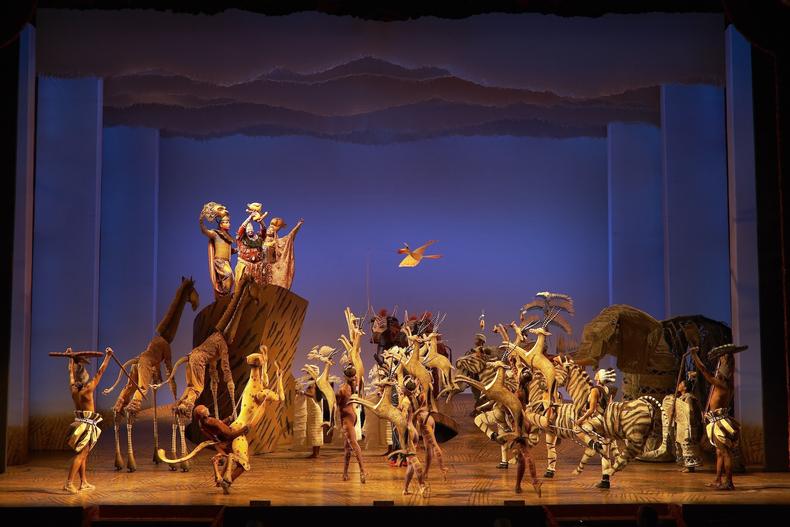
Often, the opening number is also known as a “happy village” song: a scene-setting moment that swiftly establishes where the musical is set and who it’ll be about. Such openers often take a broad view or wide sweep, rather than just introducing us to our main characters. That allows for an energetic start to a show, featuring multiple voices and populating the stage with life and movement. These are very obvious in Disney musicals, for example. Think of Belle from Beauty and the Beast, in which Belle introduces us to everyone in her village, or Circle of Life from The Lion King, where audiences are wowed by all the animals gathering.
Of course, the village doesn’t technically need to be happy; an opener can (and often does) set up the tension at the heart of the show. To pick an example from Sondheim himself: Consider the repetitive, cacophonous title-track opener to Company, in which the friends who surround the protagonist, Bobby, all clamour for his attention. Sondheim uses the hectic score and lyrics to immediately immerse us in Bobby’s fast-paced New York social scene and establish his ambivalence toward his friends and their relationships.
Viertel identifies the “I want” song as one that usually happens early on in Act 1, when the leading character or characters tell us explicitly their heart’s desire, their ambition, or their goal. It helps audiences get a handle on character, and it’s a motor for the plot: What will they do to get what they want? What obstacles will be thrown in their way?
This can be an opening number, and it’s sometimes called an “I wish” song – and we’re back to Sondheim, whose most audacious opener is in Into the Woods, a 15-minute prologue in which multiple fairytale characters are introduced (giving us the “happy village” setup) and then immediately and explicitly tell us what they want. Cinderella sings “I wish to go to the festival,” Jack sings “I wish my cow would give us some milk,” the baker sings “I wish we had a child.”
Other classic “I want” songs include The Wizard and I from Wicked, My Shot from Hamilton, Wouldn’t It Be Loverly from My Fair Lady, and Somewhere That’s Green from Little Shop of Horrors.
Most musicals feature a romantic story, but love that comes easy isn’t terribly dramatic. Enter the conditional love song: A central couple circles each other, uncertain; the promise of love is tempered by an “if,” or the hope for love is hidden under a pretence of indifference.
Probably the most famous example is If I Loved You from Rodgers and Hammerstein’s Carousel, in which two characters sing about what they’d do if they loved each other (while maintaining that they don’t). People Will Say We’re in Love from Oklahoma!, with all its instructions for what not to do, comes close behind: “Don’t throw bouquets at me / Don’t please my folks too much / Don’t laugh at my jokes too much / People will say we’re in love.”
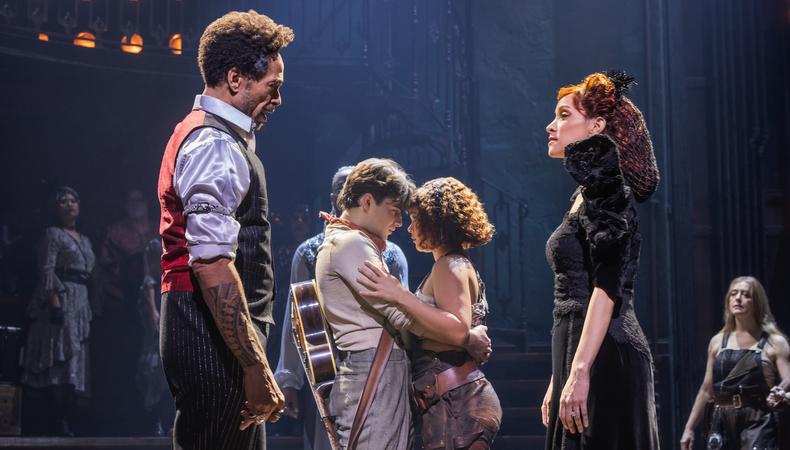
Anais Mitchell, on her Talking Hadestown commentary album, identifies Wedding Song from her musical as a conditional love song. It features Eurydice challenging her lover, Orpheus, to answer the “if” of how they will afford a wedding: “Lover, tell me, if you’re able / Who’s gonna lay the wedding table? / Times being what they are / hard and getting harder all the time.”
Everyone has spent the interval eating ice cream, necking wine, getting annoyed at the queue length to the ladies’ loo, or gossiping with friends. So how can a canny musical writer get an audience back in the zone for Act 2? By giving ‘em the old razzle dazzle, of course!
The first song of the second half usually goes off with a bang, grabbing attention. Of course, there are many ways to draw your audience back in. Some opt for the soft landing of a charming but fairly irrelevant big number: Consider This Was a Real Nice Clambake from Carousel, cheerfully slipping us back into the world of the musical without saying much. They may offer a vehicle for a spectacular dance sequence, such as Fidgety Feet from An American in Paris, which provides an excuse for a lot of fancy footwork, or Too Darn Hot from Kiss Me Kate, which escalates a sultry complaint about the weather into an all-singing, all-dancing showstopper. Masquerade from Phantom of the Opera, meanwhile, provides a different kind of clobber-you-over-the-head spectacle by staging a staggeringly sumptuous masked ball with dazzling costumes.
But the top of Act 2 can also be a moment for a truly stand-out tune that audiences will be bowled over by or, in revivals, will be eagerly anticipating. The second half of Evita opens with Don’t Cry for Me Argentina, while Act 2 of Rent starts with Seasons of Love – each show’s most famous number, and one which no one wants to miss by lingering too long in the foyer. It’s another way to get bums back on seats and the show back on the road.
Even if you haven’t heard of “I want” or “happy village” songs, you likely are familiar with the “11 o’clock number” epithet. It’s applied to a great, emotional-climax number near the end of Act 2, so named because that’s about the time it would’ve been kicking off in a Broadway show back in the days when musicals started later. It’s not usually the cast’s grand finale, but more often a significant, personal song for one of the main characters – when they realise or learn something about themselves and have a moment of reckoning. It’s also usually technically challenging, requiring a barnstorming, showboating solo performance (and so can make an impressive audition song, provided you have the pipes).
Rose’s Turn from Gypsy is widely considered a classic 11 o’clock song: a great unmasking in which Mama Rose’s fierce frustration and desperation bursts out and she commands the stage. Lot’s Wife from Caroline, or Change exhibits a similar desperation, with the Black maid Caroline asking God to turn her into a pillar of salt rather than letting her be eaten up by hate.
Cabaret, the 11 o’clock number in the musical of the same name, has a similar raw force: Sally Bowles’ hymn to escapist nightlife can be defiant, but it can also darken and sour poignantly, while Send in the Clowns from A Little Night Music also walks the line between defiance and wretchedness. A degree of spirited resistance seems a necessary ingredient for these songs. Even in a mournful ballad like Memory from Cats there is a certain soaring, irrepressible grandeur.
If the 11 o’clock number is the last big plot or character flourish of a show, and a chance for a star to shine, it’s also usually followed by a closing number: a moment of resolution and togetherness featuring the whole cast, when everyone comes together for one last song. Sometimes the closing number is a stand-alone tune that helps wrap up the show and offers emotional resolution, as with the stunning Being Alive from Company, or provides a feel-good party to send audiences off into the night with a smile on their face, as in You Can’t Stop the Beat from Hairspray. But more often the closing number is a reprise of an earlier tune, as in Les Miserables’ repeat of Do You Hear the People Sing?, or a kind of finale mega mix that mashes up the tunes from throughout the production in a celebratory last hurrah, as seen in everything from Six to Starlight Express to Mamma Mia!.