
Postproduction is the final stage of production and begins when shooting is done. Raw footage is put into order, with audio and any other effects added before distribution and release.
Many key creative decisions are made during postproduction, and it’s recognised at major industry awards. For example, Richard Gadd’s Baby Reindeer won the 2024 Emmy for Outstanding Picture Editing for a Limited or Anthology Series or Movie. Benjamin Gerstein was part of the team that edited the hit Netflix series. He describes the role as “a really exciting creative responsibility [where you get] to work with interesting, dynamic people from so many departments. But way in the back, far from the house lights!”
Here’s what you need to know.
JUMP TO
It’s time-consuming to put raw footage together and transform it into a cohesive story.
A one-hour television documentary will need several weeks, while a rough cut for a feature film can take several months. But, depending on the project, it can take as long as a year.
Postproduction arranges raw footage into a synchronised narrative and adds aspects like dialogue, music score, sound, and visual effects.
It normally begins after principal photography has wrapped (that is, after the cast and crew have finished shooting scenes), but sometimes editing and other postproduction processes, like VFX (visual effects), begin during filming.
It’s an involved process with a lot of choices to make, and it’s carried out by a team of experts across departments, including editors, sound engineers, Foley artists, and colourists, who add and polish details to create a production ready for distribution.
It often requires creatives to zero in on a particular aspect of the production, such as the sound.
“One of things I started doing very early on in my career and still do on each project is to review the edits of a scene mute. I find I can feel the rhythm of a sequence much easier without the sound. And often I’m surprised with what I find when I turn the audio back on,” says Gerstein. “For me, musicality is a really important thing in editing, directly in terms of how to use music. But also in terms of understanding and manipulating rhythm and pace throughout a drama.”
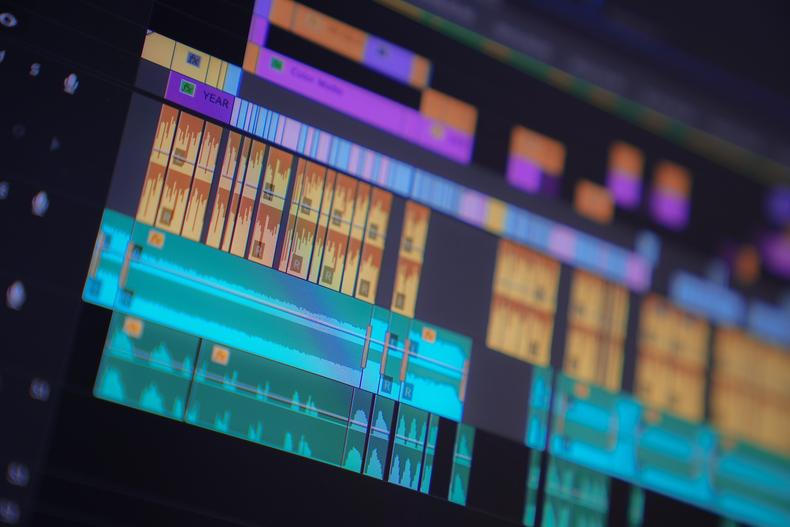
A HIP A HUB STOCK/Shutterstock
Picture editing
Here, the editor views and selects individual shots to form a coherent narrative and cuts the footage in a way they feel will enhance the overall storytelling. Depending on the project, the editor might take the lead on this or work alongside a director or edit producer.
Sound editing, mixing, and design
Sound is a key component of the postproduction process and involves significant work, from adding dialogue and sound effects to removing background noise and putting together audio tracks. To market a film on a global scale, there also needs to be a soundtrack that does not include the original dialogue in English, so it can be dubbed into another language. This involves drafting a script that includes the precise time code for each word that is spoken.
Music production
Most films have a musical score, for which a composer creates an original music composition, or use of existing music, which has to be woven in.
VFX
VFX is the art of combining computer-generated (CG) sequences with live-action footage to create scenes that can’t be filmed in real life. Think of Dune, which used “sand screens” instead of green screens to realistically replicate sand dunes, and Tenet, where the art, stunts, and VFX teams collaborated to create impressive scenes like the reverse car chase.
After the picture has been “locked” (when the director and editor approve the final cut), VFX artists can begin work. Sometimes, though, visual effects are generated before the film has completed production.
Colour grading and correction
Colour grading uses a variety of mechanisms and devices to colour-correct the look of footage in terms of brightness, colour saturation, and other visual elements.
This stage rarely begins before picture lock, but contributes to the final “mood” of a production by defining its colours. In a process called “grading,” colourists work with the director and the director of photography to decide the colour palette and “look” of the feature. For example, The Godfather (1972) used colour grading to create its iconic look, using a vintage orange-brown tint that evoked the 1940s era of the film.
Motion graphics
After the above steps, editors create and add in title cards, credits, and graphics that are required, like date stamps. Credits need to be accurate and professional – and there are rules that must be adhered to – but they also present an opportunity to be creative and set the tone for the story, particularly through graphic design, as seen in the opening sequences for Catch Me If You Can (2002), Napoleon Dynamite (2004), and the TV series Severance (2022–present).
Distribution preparation
Examples of the distribution process include creating a campaign poster and trailer.
- Postproduction supervisor: Supports the producer in managing every step of the postproduction pipeline, including financial processes.
- Edit producer: Works with an editor to create content from the “rushes” (raw video material).
- Deliverables producer: Encodes and delivers files of a completed production in correct formats.
- Tech ops supervisor: Oversees day-to-day operation of a postproduction house, including security of data stored on servers.
- Supervising sound editor: Manages the sound team and after-picture lock, and helps decide any ideas for the overall theme of the sound.
- Foley artist: Creates sound effects or re-creates sounds to accompany footage.
- Sound mixer: Adds background noise, voiceover, music, or sound effects.
- Sound designer: Combines music, dialogue, and Foley effects to create audio tracks.
- Composer/music supervisor: Scores or secures the music.
- Colourist: Colour-corrects files.
- Cinematographer: Ensures the colour and feel of all shots is true to the film’s style, in addition to their role across preproduction, production, and postproduction processes, including reviewing footage for the final edit.
- ADR editor: Records additional dialogue like re-recorded conversations and voiceovers.
- Dubbing mixer: Mixes together different sound elements to create a final soundtrack.
- Subtitler: Provides subtitles (translations) or captions (for deaf and hard of hearing audiences).
- Motion graphic designer: Creates graphics and assets like opening sequences, captions, titles, credits, and logos to create a consistent “look” that supports the tone of the production.
- Archive producer: Responsible for sourcing archive footage, negotiating a rate, and getting permission to use it.
The global postproduction market is set to grow by almost US $18.4 billion from 2024 to 2028, which means there will likely be plenty of job opportunities.
In particular, demand for VFX services continues to increase, with the rise of virtual and augmented reality content, as well as advanced technologies like AI, investments in 4K production, ongoing trends in digital marketing, and personalised, high-quality content across multiple platforms.
Writer/producer Shawn Basheer agrees on the importance of staying alert. “Keeping a pulse on how AI evolves and learning how to leverage it will give you an edge, especially since many seasoned pros may be hesitant to engage with it,” he says. “Being ahead of the curve in this space could set you apart.”
Huge strides have been made to increase diversity in the entertainment industry, with more female directors and producers, but postproduction still appears to lag behind. The founder of one postproduction agency suggests that postproduction should be marketed not necessarily as a technical skill, but as an “artform,” which may attract women in the numbers that fine arts programs do. After all, there are many artistic roles, from animation to VFX, which are growth areas.
Traditionally, the UK’s major postproduction houses are in Soho, London, but major studios like Pinewood, Elstree, and Warner Bros also have their own post facilities, while larger broadcasters have moved out of London to set up bases in cities like Cardiff, Manchester, and Glasgow. There are also many smaller independent companies across the UK, and superfast broadband means many picture editors can cut programmes from home.
Working in postproduction is a creative, technical, and collaborative process involving a variety of skills, often with irregular hours working indoors, sometimes without natural light.
As technology is always changing, you will need to learn and be aware of emerging trends.
There is no set route to a postproduction job. A university degree isn’t required, as it’s more about technical skills and craft. Some companies offer apprenticeships, or they’ll take on runners, trainees, or edit assistants, who then have the opportunity to work their way up and eventually specialise. Creating a show reel of work and networking will help.
You’ll probably need to freelance for part of your career, but you could move into managing a team or setting up your own postproduction company.