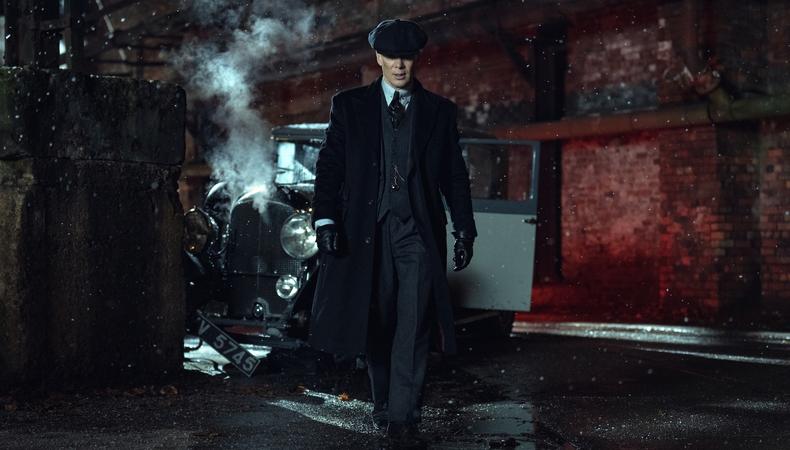
Ruthless aggression and complex machinations; murder, extortion, and prostitution; three-piece tweed suits and flat caps – this is the world of Peaky Blinders. Six seasons drew viewers from around the world into the Shelby family’s bloody rise from street enforcers to crime kings, and now the story concludes in a blockbuster film: Peaky Blinders: The Immortal Man.
Defined by violent action, complex antiheroes, and Western-inspired storytelling, the show has also offered seminal roles for some of Britain’s best-loved actors. We round up some of the acting lessons they’ve gleaned from their own formative experiences both on and off the Peaky Blinders set, some of which could even spur on your own acting journey.
This is acting advice – by order of the Peaky Blinders.
Getting started
“I get asked a lot by young actors and directors: ‘What should I do when [I’m] starting off?’ And I say to them, ‘You’re carrying around a very sophisticated camera and editing suite in your pocket!’ Go and make something and put it up on YouTube.” —Cillian Murphy (Tommy Shelby)
“How long do you keep pursuing what you really want to do? Never give in; try to keep going. And if you’ve exhausted every single avenue and you can’t quite get that break, just keep knocking on doors, keep sending stuff, keep trying to get auditions.” —Stephen Graham (Hayden Stagg)
“I did five plays back to back over three and a half years.… It was like a second training. I was sitting there with, you know, Judi Dench and Bill Nighy and Norman Rodway and all these people.… You just sat there and watched, you know, ‘What are they doing? What are they doing? What are they doing?’” —Helen McCrory (Polly Gray)
“When you’re given a bad script and it’s terrible, you make it great.… All those terrible jobs or terrible auditions, it’s all tool to your craft and gives you a deeper well to draw from. And it perfects your craft because you have to work harder to make it better.” —Annabelle Wallis (Grace Burgess)
Approaching a role
“What’s important to me is that if you’re doing something as an actor, if you’re going to commit, then make the effort to fully commit, even if you fail. It doesn’t matter. I’d rather go out swinging, trying something to make the effort, than not make the effort at all, because there doesn’t seem to be any point in playing safe.” —Tom Hardy (Alfie Solomons)
“I have empathy for all of the characters that I play. I think the most important tool you have in your kit bag as an actor is empathy. The definition of empathy is to walk in another person’s shoes, and that’s what we do as actors. And you don’t have to agree with them, but you must above all never judge the characters.” —Cillian Murphy
“Each one you’re drawing something different. If you’re asked to play that part, it’s because they see something in you and in that, and that’s one facet of your personality.” —Sophie Rundle (Ada Thorne)
Preparing to perform
“You must research the period. You must research the author. You must research the condition. You must do this. This is your job, because you will be sitting night after night in front of people that may be far closer to this character than you, and it is your duty to speak for them.” —Helen McCrory
“I just can’t stop playing around with the different ideas in my head. It’s strange; I have this very clear image of myself as the character on set.” —Paul Anderson (Arthur Shelby)
“Learn your lines, and don’t have coffee.” —Annabelle Wallis
The gift of acting
“I think curiosity is the reason I do this as a job. You can feed the curiosity by playing different parts and meeting such interesting people.” —Natasha O’Keeffe (Lizzie Stark)
“[When considering a role, I look for] three things. One: Do I love my character so much that I’d do anything for her? Two: Did the script give me that insane feeling in my body? And then three: Would I follow the director to the end of the Earth? Yes? OK, I want to do it.” —Anya Taylor-Joy (Gina Gray)
“If you’re watching someone and recognise something in that performance or that character, even just for a moment, that’s so elusive and so rare. If people have even a moment of that with anything I’ve been in, I’d be delighted.” —Sophie Rundle
Growing as an actor
“I never want to feel like I’m just comfortable. If a role scares but excites me at the same time, I’m like, ‘That’s good.’ Whether it’s the size or the emotional integrity or just the technical difficulty, I always like feeling that the role is just a little bit out of my reach.” —Daryl McCormack (Isaiah Jesus)
“Live. Try. Fail. Try again... Just go for it. And it’s a hard job, it’s a really, really difficult job and it takes a lot of time. And you do feel sad a lot and you feel under a microscope. And the more you get to know yourself, the more grounded you can be in this world of scrutiny.” — Rebecca Ferguson (Kaulo)
"You can learn a lot from drama school, but you can learn much more when you’re working.” —Stephen Graham
“You can never get complacent. I think I am sort of obsessed with my job because I feel that you really do get better every time that you do it, and you learn something every time that you do it. And I just think it is incredible to have that in terms of your job. There is no such thing as perfection; you are driven by a mixture of fear and a desire to develop.” —Amber Anderson (Lady Diana Mitford)