
Choosing the right dramatic monologue for an audition is about showcasing your emotional range, depth and ability to connect with complex characters. If you’re preparing for drama school auditions, you may be tasked with finding contrasting monologues, and the examples below will pair nicely with comedic monologues.
JUMP TO
A strong dramatic monologue should:
- Showcase emotional range: The piece should allow you to demonstrate a variety of emotions.
- Have high stakes: Your character should have something at stake that drives the speech forward.
It’s wise to pick a text that’s age and gender appropriate. It can help, too, to pick a monologue that fits your casting type to ensure authenticity.
Simon Ratcliffe, senior lecturer in voice at the Royal Birmingham Conservatoire, advises choosing a monologue you personally connect to. “You want to look for a speech that moves from thought to thought, where you end up in a different place from where you began. You want to find a speech that expresses something you know, but in words better than you could say it yourself,” he says.
Ratcliffe, who regularly sits on audition panels and coaches students in monologue preparation, says that you should be prepared to live with the monologue for some time and be flexible in your approach. “If you’re using the monologue to apply for drama school, then you should be able to do it in different ways so that you can quickly respond to direction.” In terms of performance, he suggests making bold choices: “Don’t get stuck in one place: every breath can be a moment of change.”
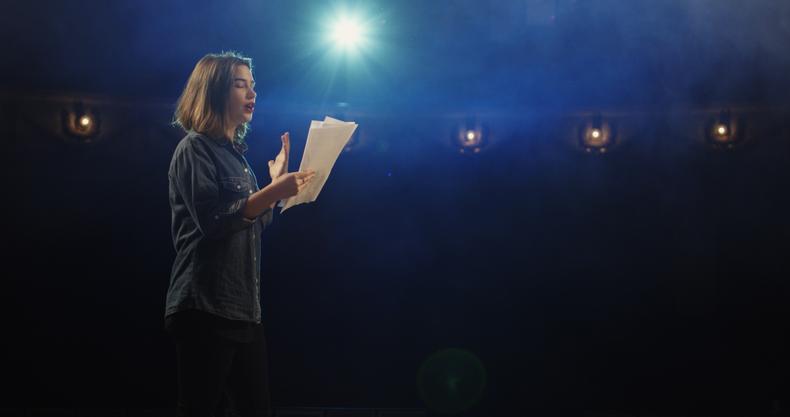
Frame Stock Footage/Shutterstock
Here are some brilliant dramatic monologues that play to different casting types, ages and genders. If delivered powerfully, each has the potential to be infused with intense emotion to help drive your portrayal of the character.
Goodness by Michael Redhill (2005)
Act 2
Character: Althea
Situation: Althea is an ex-prison guard living in hiding. In this monologue, she recounts the brutal treatment and murder of her family and friends by intruders, leaving her as the sole survivor to bear witness.
Why choose it? The monologue is deeply rooted in trauma and grief, allowing you to explore a wide range of intense emotions, while Althea’s vulnerability in recalling the events and her strength in surviving and telling the story create a compelling duality to explore.
They took my parents to the edge of town and just shot them.
Left the bodies uncovered in a field. I found my father's suit jacket on a skeleton five months later. His best suit.
And then, after that, taking people away somewhere was too much trouble. They just came and killed. They found me and my sister and her husband, their little boy, and some friends of ours, and they made us go to a church.
They pushed us up to the altar - where we read from so many of the same texts as they did in their own churches - and they made us perform. We had to sing our old national anthem. They told us to stand on one leg and said we were storks and said they were storks, too. Pointing their guns at us. If you put a leg down, they acted surprised and said that you were only pretending to be a stork and then they shot you. My nephew, Domenic, began laughing when my sister put her foot down. And they said to him, ‘Why are you laughing?' and he said it was because, of all the things that could make you die, imagine that it would look like a schoolyard game. They took him out of the line and put the gun in his mouth and told him to laugh some more and they would spare him. And out of him came this unworldly laughter, as if the sun and the moon were laughing at the stupidity of being human. It was a real laugh, a deep, deep laugh. And they shot out the back of his head and he stopped.
They killed us all. Except me. I was last and ... they sent me home. I don't know why. (Beat.) Maybe so there would be one person left to tell of their might.
Althea begins to sing very quietly to herself
Burying Your Brother in the Pavement by Jack Thorne (2008)
Scene 10
Character: Tom
Situation: Tom is grieving for his dead brother, Luke, and coming to terms with the memory of the night he died.
Why choose it? The monologue navigates a range of emotions, from confusion and sadness to anger and realisation. This allows you to showcase your ability to handle complex emotional transitions and convey a deep, layered performance. The subtext of Tom feeling less loved or appreciated compared to his brother adds depth to the monologue, allowing you to explore the journey from these feelings of inadequacy towards self-acceptance and understanding.
The night he died – they basically forgot about me. Courtney said she heard Mum crying, and woke then, and came downstairs to find out. But I didn’t hear anything. He hadn’t come home, I knew that before I went to bed, but I figured he was just with mates, even Mum wasn’t worried, so I slept well and slept deep. Anyway, about four a.m. I woke up and I needed a piss, and a glass of milk, so I went downstairs. And Mum was in tears and sitting in a corner of the kitchen on the floor and Courtney was standing crying and Dad was just really really angry – saying things like ‘well, what the hell was he doing down there’. And there was a police officer making everyone tea and trying to look unobtrusive and I – was – seeing all this was like – I just – and I didn’t know what had happened.
Anyway, so I ask ‘what’s going on’ and they all turn and look at me – and they didn’t want to explain it all again – my parents didn’t – so the police officer said – because she knew they didn’t want to explain it again ‘I’ll take him in the living room, shall I? Let him know what’s happening’. And Mum just nodded.
They’d told Courtney themselves, but that was probably because they knew she’d have a better reaction than me, and they wanted to hug her and stuff. I was never the sort of boy that people hugged, Luke was that sort of boy, I was – I’m the sort of boy people pat. On the back, head, or arm… Anyway, when the police officer told me and I asked ‘are you sure’ and she said ‘that’s a strange response’ and I said nothing and that I probably needed to go to my room for a bit and she said okay and then I went and sat in my room and played Solitaire on my computer. And –
He’s not going to be buried here. They’ve put him in the ground already. They’re hardly going to dig up the body to put in a concrete hole. But this is – my burial, isn’t it? The time I’m burying him, for me. And I know him now and I know what I’m burying and I know what he means to me now, I know that I love him.
Miss Julie by August Strindberg (1888), translated by Michael Myer
Act 3, Scene 1
Character: Miss Julie
Situation: Miss Julie, in a state of intense emotional turmoil, confronts her lover Jean after a series of degrading events. Her speech is filled with anger, despair, and a profound sense of betrayal.
Why choose it? The monologue is charged with raw, visceral emotion and a strong emotional arc as Miss Julie’s feelings evolve from rage to a mix of self-loathing and despair. This dynamic range allows you to show depth and complexity in your portrayal.
Kill me! Kill me too! You, who can kill such a tiny, innocent creature. And your hand didn't even tremble! Oh how I hate you, how I despise you! Now there's blood between us. I curse the moment I first saw you. I curse the moment I was conceived in my mother's womb. (She approaches the chopping board as if drawn to it against her will.) No, I won't go yet. I can't . . . I've got to see ...
Shh! There's a carriage coming. (She listens, but keeps her eyes fastened on the chopping board.) You think I can't stand the sight of blood, don't you? You think I'm so weak. Oh I'd love to see your blood – your brain – there on that chopping board. I'd love to see the whole of your sex swimming in its own blood just like my little bird! I feel I could drink out of your skull, bathe in your broken chest, and devour your roasted heart. – You think I'm weak! You think I love you, that my womb yearns for your seed, that I want to carry your child under my heart, feeding it with my blood. Bear your child! Take your name! Oh now just a moment... what is your name, anyway? I've never heard your last name. I suppose you don't have one, do you ...
I'd be 'Mrs Hovel' or 'Madam Dunghill'. You dog, you, sporting my collar – you valet with my crest on your buttons! You think I'm going to share you with my cook – have that servant as my rival! Oh! Oh! Oh! . . . You think I'm a coward and I'll just run away. No. I'm staying put – come what may. My father will come back ... find his desk broken into . .. his money gone. Then he'll ring that bell – the usual two rings, Jean ... for his valet ... he'll send for the police... and then... I shall tell him the whole story. Every single, little detail! Oh it'll be wonderful to have it over and done with ... if only it will be over ...
Then he'll have a stroke and die. That will be the sad end of our family. There will just be peace and quiet... for ever and ever. The family coat of arms will be broken over his coffin – the noble line extinguished. But the valet's line continues on in the orphanage, wins glory in the gutter and ends in jail.
The Treatment by Martin Crimp (1993)
Act 2, Scene 2
Character: John
Situation: John is an actor who has been brought into a film project that is being produced by his ex-girlfriend Jennifer and her fellow producer Clifford.
Why choose it? This monologue hints at complex dynamics between John and Jennifer, including past intimacy, shared activism and present embarrassment, which gives subtext that can be explored in performance. The dynamic shifts in tone let you show your range.
Jennifer and I go back a long way, Clifford, a long long way. I remember her with hair down to her waist and that sweet sulky mouth of hers screaming at the police, don’t I Jen. (Faint laugh.) Look at her. She’s embarrassed. But why?
I can remember her lying down in the street to protest. I remember because I lay beside her, Clifford. That’s how far back we go. Side by side. In the street.
We felt that our actions – what? – might – yes – might transform the world. Plus felt that if our own relationships were free of the tensions of race, sex, money, then the world itself would alter. In the way that if you begin to grow plants in a stagnant pool, over time the body of water will become clear. (He laughs at the naivety of this idea.) We saw this happening not for ourselves, but perhaps for our children. Not that we had children, Clifford. Since as I’m sure you realise, it’s one thing to hang out with a black man, but something else again to marry him, to have his children.
JENNIFER looks away. JOHN is amused by her embarrassment, but not bitter.
And if I didn’t still possess such a strong picture of the girl who lay down beside me to protest about something I have entirely forgotten, then I would not – Clifford – contemplate getting involved even for one moment in the kind of degrading shit that has become her trademark.
A moment, before JOHN begins to laugh.
Come on, Jen. A joke.
Bodies by Vivienne Franzmann (2017)
Scene 10
Character: Clem
Situation: Clem tries to convince her old-fashioned socialist father why she has paid a surrogate to carry her child.
Why choose it? The monologue taps into deep, raw emotions of pain, loss and longing and gives you plenty of opportunity to showcase your range, from conveying deep sorrow and vulnerability to expressing anger and frustration.
Do you have any idea what it’s like not being able to have a child?
—
—
It’s awful.
—
—
The pain is… the pain of it is…
—
—
I can’t escape it. Everywhere I look. Everyone I know. Everyone I meet has children. It’s impossible to… it feels so… It’s impossible. And they always ask me if I have any. I cannot get away from that question. And when I say no, they don’t know what to do, because it’s… it feels… I watch them search about where to go next, is it okay for them to carry on talking about their kids or should they find something else to talk about? And then they decide it’ll look worse if they change the subject, so they carry on about Lola’s art class or Harry’s option choices or the family holiday in Cornwall as if I give a shit. And the more they talk, the more they know who they are, what they are part of; their unit, their little gang. They are so certain of why they are here.
I’m a mother. What are you?
Then they see me fading away and start complaining about how rude Joseph is, how Tilly is being bullied and Maisie is out of control and how tiring it all is, never having a moment to yourself, an inverse to all the positives. It’s pity and we both know it. And I fucking hate them for it. Not having a child makes me hate everyone who does.
—
—
—
—
—
When you have one of your own everything shifts. That’s what they say. You recalibrate. Your world view completely changes, because of the love you feel for your child. The overwhelming, all-consuming, undeniable –
—
—
I wake up every morning with this ache, with this gnawing feeling of loss and displacement and horror that this is it for me. This is all my life will ever be.
—
Is that what you want?
—
Is it?
—
Is that what you want for me?
—
Say something.
—
Speak.
—
Speak.
—
The Unreturning by Anna Jordan (2018)
Act 3, Transitions
Character: Frankie
Situation: A soldier has returned to his hometown of Scarborough after fighting in a war, and the homecoming isn’t as he had imagined it.
Why choose it? There is a strong emotional journey in the monologue as the character moves from sadness and guilt to a desperate plea for change, and finally to a glimmer of hope. This narrative arc lets you demonstrate your range and ability to take the audience on a journey.
I run from The Lion to the shore. Coming down off the coke now, so no more Billy Big Bollocks. I just feel fucking sad. Sad for Ket, he didn’t mean any harm and I broke his nose. Sad for Rusk the newbie with his limbs hanging in the trees and for Badrawi Kabir, whose name means ‘Beautiful, radiant’ and who will never walk again, because of me.
Sad for Mum, when she reads tomorrow about her monster son. Sad for Kayleigh, and Jenson and Nan – their Scarborough war hero told the world he feels like he comes when he kills a man. Sad for the man I could have been.
I take my shoes off. Ice-cold sea on white feet. Taste blood. Squat. Sand in my fists, wind in my hair, spit blood in the water. Blood and sand and the salt of my tears and the sea.
I howl at the sky and roar at the waves: SAVE ME OR FUCKING DESTROY ME.
I want to be the waves.
I want something to change.
I want all this pain to make the sky turn red.
Or crack the surface of the earth.
Watch the sea wall lashed
Watch the waves swallow the cars and the houses and the
people on their sofas watching telly, in their bedrooms
making love.
But nothing changes, there is nothing except the dark forever.
But there. A light? A light… A light!
A tiny boat far out to sea. Where are you going? Can you take me?”
The Hills of California by Jez Butterworth (2024)
Character: Veronica
Situation: Veronica confronts Jack about broken promises and the dwindling hopes of the Webb Sisters, who are her singing daughters. She expresses her frustration and disappointment over Jack's failed assurances and the lack of progress in their careers.
Why choose it? Veronica is a strong, assertive character with a clear sense of urgency and purpose. In this monologue, the stakes are high because she feels she’s reaching the final chance of success for her girls. The speech includes several shifts in tone, with Veronica moving from sarcastic jabs to heartfelt confessions, and these transitions provide opportunities to showcase versatility and depth.
Don't you fucking Ronnie me, you soft 'ap'th. 'I know Jimmy Bairstow. I know Doris Day! Last week I was in The Alhambra with Al Martino telling him all about you.' 'Were you, Jack? In that case, forget the rent.
You can just take my money and piss it up the wall? You said Max Bygraves's manager promised next time he was in Blackpool he would come here, to this house, and audition my girls. That was ten months back. So where is he?
Where's Mr Manager?
Pause.
I know the body runs The Feldman. Him what books The Queen's. The North Pier by June. Mark my words. June, Veronica. Mark it on the calendar.' It's May the first, Jack.
Where's the phone calls? The contracts?' 'Oh look, it's Mersey Week.' Aye, and my girls learned 'Molly Malone'
'The Rose of Tralee'. With all the steps. Why? Because you said you could get them on the lunchtime roster at The Palace. Now half the world's here, buying tickets, looking for fun, something special, something to remember. And they'll come and they'll go back home and not one of them will have heard word nor whisper of the Webb Sisters. Why?
Because they're a mile out of town, stuck in this stinking kitchen, rotting.
Pause.
This act were better six months ago. It's going off the boil.
It kills me to admit it. But if I can feel it they can feel it. In their little bones. They think I'm lying to them. Why?
Because I am. I look in their eyes and I can see the fire going out. Now I will not sit back and watch their dreams die.
Because that's what's happening. That's what's happening right now.
Pause.
You're living here on hot air and tick, Jack Larkin. I've had it. Give me three months' rent or get. I must have been crackers to listen to you.
Silence.
Cold War by Conor McPherson (2023), based on the 2018 film by Paweł Pawlikowski
Act 2
Character: Wiktor
Situation: Wiktor is serving 15 years in a labour camp when the love of his life pays him a visit after a long period of separation. He tries to convince her to move on by telling a story of how he betrayed a woman during the war.
Why choose it? This powerful monologue in which Wiktor confesses to an incident about which he feels deep guilt lets you explore the character’s sense of self-loathing, sadness and grief, with the added tension that he is saying it to a lover who may disown him when he gets to the end of the story.
I never told you, I had a piano teacher. She was very kind to me. In my first-year exam she told me I had an unusually delicate touch. Too tentative. She offered to help me.
She was twenty years older than me, she was married, but she and her husband lived in adjacent apartments so… I began to spend a lot of time there.
It was the thirties, late thirties. She even found me work. When the Germans invaded Czechoslovakia her husband was offered a residency at Princeton University. They were Jewish, you see. And she offered to pay for me to join them. But I felt things were just beginning to happen for me in Warsaw and I told her… I couldn’t. Told her she should go. To tell you the truth, I also just kind of wished she would go… because, you know…
Anyway she stayed. Probably for me. Her husband left. And she… And the war came. And then all the Jews were ordered into the… They were going to wall them all in.
Naturally, she didn’t want to go. She gave me all of her manuscripts to hide, Polish music and pieces that we had worked on and I… Anyway, we snuck her into an office. We hid her there, but down, two floors down under the ground in a… kind of large… cupboard really behind a septic tank. She was locked in there. It was safe, it was sound-proof. But it was… Weeks went by like this. Then someone from the faculty warned me that the building was being watched and I just didn’t… go there. I’d walk towards that street, with some food in a little bundle, but I’d see a car, or someone under a street lamp or I’d hear a voice in the darkness and, any excuse, I’d just… turn round, and go back to work. And play. Yeah. And I would hope that she had… just, in the dark, just… She loved me. And I… I took… it. And that is who I am. Just do me one favour, will you? Find some normal man. An ordinary man with an ordinary life.