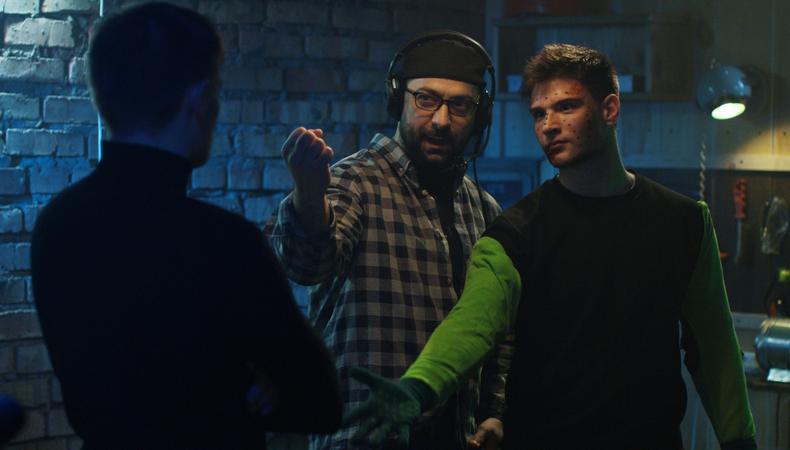
Exhilarating as a film’s final product often seems, there’s a lot of standing around on set. As a stand-in, you’ll be needed when the cameras aren't rolling, taking the place of a principal actor (one with a speaking part) and walking through their movements to help lighting and camera crews set up for the shoot.
The position of stand-in may be a stepping stone to principal actor status or become a career in and of itself. Either way, it’s a challenging and competitive role in which you’ll be required to work professionally with a set’s most influential crew members.
Here’s what stand-ins do, why the work is worth pursuing, and how you can earn your stripes.
JUMP TO
Principal actors are busy even when cameras aren’t rolling. When they’re in makeup, in costume, on a break, or otherwise needed elsewhere, it’s handy having a stand-in so the camera and lighting teams can set up in their absence.
That’s the stand-in actor’s job; they’re part of the second team, while principals are part of the first team. Here’s the stand-in actor’s day-to-day routine.
- Rehearsal: After private rehearsals (which only a few core members of the production team watch), stand-ins and the rest of the second team are called to watch a “marking rehearsal.” Marks are laid on the floor with tape, and you’ll note how, where, and when your designated actor moves.
- Second team rehearsal: The first team steps away and you step in, heading to your mark and walking through the steps of the scene – also known as “blocking.” The director of photography will observe how light is hitting your face and body, while camera operators frame you in each position.
- Second team dismissed: You’ll step away to find a monitor, noting any changes in blocking that your designated actor will need to know about.
- Repeat: Once you hear “Checking the gate!” (sometimes “Check that!” or “Checking the chip”), head back for a new scene’s setup or rehearsal, or possibly another run-through of the scene you just did should any major changes be required.
Doubles replace actors onscreen when their face is obscured or a dangerous stunt needs to be performed, but stand-ins work when cameras aren’t rolling and don’t appear onscreen.
A TV or movie star stand-in isn’t necessarily a principal’s double in terms of physical appearance, but they usually have the same skin tone, hair colour, build, and height.
Some productions may use the same person as a stand-in and double, but they’re different roles.
It may seem a sideways rather than upwards step in your career (especially if you’re an aspiring actor), but work as a stand-in can be surprisingly fruitful.
It’s a chance to learn: “You can learn how to act in an acting class, but you don’t necessarily learn how to be an actress there,” says Rebecca Bujko, a stand-in for actors like Scarlett Johansson and Amy Adams. “[The set] is where you learn about delivering dialogue, hitting your mark, or even wearing an uncomfortable microphone under your clothes.”
Being on set every day and seeing a show or movie from start to finish offers endless opportunities to learn from some of the best in the business. “I've been standing in nonstop now for 13 to 14 years, and it has been better than any acting class that I've ever taken,” Kyle Humphrey, who has stood in for Meryl Streep and Julia Roberts, says in an interview with Theatrik. “You are on set every day, you are a valuable part of the crew, you see the show from beginning to end...the opportunities to learn are endless.”
You’ll gain exposure: Many actors are former stand-ins. Michael Caine got his start as a stand-in for Peter O’Toole, and Samuel L. Jackson was a stand-in for Bill Cosby on The Cosby Show. “I was the right height, and I was the right skin tone,” remembers Jackson. “For two to three years, they would put his crazy sweaters on me.”
Some actors switch off between being a stand-in and a principal. Julia Walshaw, Naomi Watts’ King Kong stand-in, had a brief role in the same movie, while Humphrey says that being a stand-in has led to character roles. “I’ve been written into a film (Cat City) just by standing in on it, gotten a role on a TV sitcom (Young & Hungry) by standing in on it, and gotten three voiceover gigs (Young & Hungry, Fuller House, and Hot in Cleveland) all by standing in on the shows,” she says. Charlie Day and Glenn Howerton from It’s Always Sunny in Philadelphia have likewise mentioned giving minor parts to stand-ins who do well during read-throughs.
It can build relationships: As a stand-in you’ll have a chance to earn the trust of assistant directors (ADs). ADs often use the same stand-ins between projects, and several A-list actors stick with one over numerous projects, even writing their inclusion into contracts — stand-in acting truly can be a rewarding, full-time career. Adam Bryant was Robin Williams’ stand-in and photo double in 36 films over 25 years, while Loyd Catlett has been Jeff Bridges’ stand-in for nearly 70 films over five decades, and Scott Pierce was a stand-in for Ed Harris on several movies and two seasons of HBO’s Westworld.
1. Get on set
Your first time on a set probably won’t be as a stand-in, but the experience gained in other roles can help with the transition. “I would say that if you want to become a stand-in, you should get on set as much as possible,” says Humphrey.
More junior positions, as an extra or background actor, will get you seen, allow you to be present for last-minute casting, and (most importantly) familiarise you with working on set and how a second team operates. Simply observing how stand-ins help with blocking scenes or how they advise principal actors can be instructive.
Sign up for casting announcements and check job listings, remembering that any role that gets you on set can be useful.
2. Connect with the second team
As an extra or background actor, the background production assistant (PA) is your immediate point of contact and the (confusingly named) second second AD will direct you. These are the second team members who “pull from BG” (take someone from the background) when stand-ins are hired on the day. You shouldn’t go right up and pitch yourself to a PA or AD out of the blue, but you can make yourself known when they’re looking for people with any stand-in experience and keep your ear to the ground to know when even inexperienced stand-ins will do, especially when you resemble a lead actor.
Getting to know regular stand-ins can be tricky since they’ll be stationed near set, whereas background actors will typically be farther away. Once your first opportunity is secured, use your free time to request any tips and tricks.
3. Know the ins and outs
Stand-ins may be cast for their uncanny resemblance to an actor. Sophie Turner’s Game of Thrones stand-in was such a dead ringer that then-husband Nick Jonas mistakenly came up and kissed her, while Joonas Suotamo’s athletic 6’11” frame made him a natural stand-in for Chewbacca actor Peter Mayhew.
However, a stand-in who understands what’s expected of them generally gets the gig over one who more closely resembles the principal actor. Knowing how second teams operate and the difference between film set terms like “upstage” and “downstage” is a crucial time-saver on set.
4. Be professional
A good stand-in must be a strong team player – and able to remain positive in the face of challenging circumstances and colleagues. “You have to be professional,” advises AD Molly Rodriguez. “You’re held to a higher standard [than a background actor or extra] when you’re on the set as a stand-in.”
You should:
- Be punctual: “I should not even have to wait for ‘second team’ to be yelled,” says Rodriguez. “As soon as you hear ‘cut’, you should be ready… If I never have to look for you, you’re golden.” Production schedules and call times often change, so keep your ears to the ground on set so you’re ready to go.
- Come prepared: Seasoned stand-in Devon Elora brings a bag to set containing a few wigs and a handful of shoes with heels of varying heights – that’s how she supplemented her role as stand-in for Westworld’s Evan Rachel Wood with stand-in work for a 6’5” Native American actor. “The job,” Elora explains, “is to make everyone else’s on set easier.”
- Take detailed notes: As a stand-in for Sarah Snook on Succession, Holly Cinnamon found note-taking crucial: “They might ask me, ‘How far was Shiv leaning forward in this scene? At what point did she get up and walk across the room? Which way was she facing when she delivered this important line?’” Bring something to write with and jot down where, when, and how actors moved and interacted with props.
5. Keep your CV up to date
Experienced stand-ins can be a godsend, so let casting directors know you’re one of them by updating your resume with each role. Photos should reflect your current appearance to ensure casting gets as close to the principal actor as possible – they don’t need a dead ringer, but broader details like hair length, hair colour, and body type should be close. Get professional headshots that are well-lit with your face clearly visible and details such as hair colour and length easily identifiable. Include accurate measurements, and alter them should your body shape significantly change.