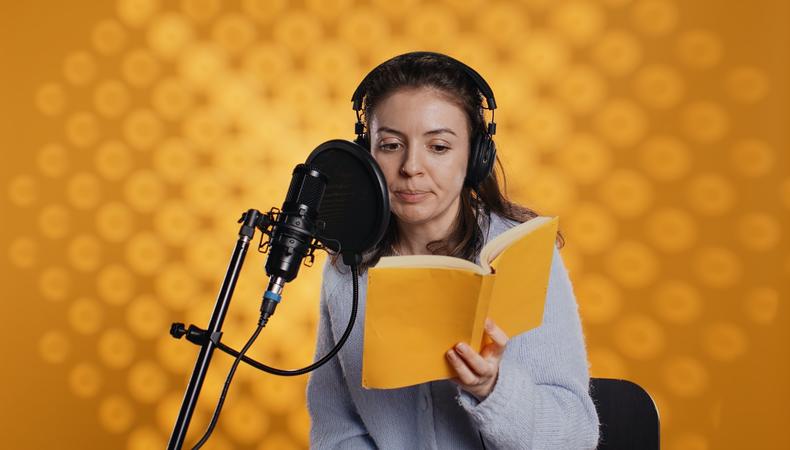
With audiobook downloads on the upswing, the demand for talented voices to bring these stories to life has never been higher. For actors and voice artists in the UK, this is an exciting time to be entering the world of audiobook narration, but where do you begin? Here are the essential skills and tools you’ll need to get going.
JUMP TO
An audiobook narrator is a voice actor who brings stories to life by reading books aloud for recorded audio. A skilled audiobook reader does more than just read, though; they embody the characters in a novel, adapting their voice to portray the different people speaking, as well as conveying the mood, tone, and emotion of the text, making the listening experience an engaging and imaginative one.
It takes a huge amount of stamina, mental agility, and technical prowess to maintain this for the duration of narrating an audiobook – you will be expected to read confidently and fluidly for hours at a time in the recording booth. If this is a skill you can master, it can be a great “bread and butter” gig for actors and voice actors between other work.
LightField Studios/Shutterstock
1. Develop your voice acting skills
The first step to becoming an audiobook narrator is to practise. Senior audio editor Rebecca Fortuin tells us it “takes a lot more concentration than you might expect” to narrate an audiobook, and practice is key. Understanding the subtleties of language and being able to quickly interpret complex sentence structures is something that will stand you in good stead when doing an audiobook recording; so, the more you practise reading aloud, the better. Voice agent Emma Torrens at VOBJ Management also suggests you “record yourself reading short excerpts of a few different books, and then listen back” in order to hone your audiobook narration skills, adding that “YouTube is your friend” when it comes to picking up tips for good mic technique.
2. Record your samples
If you want to get paid to read books in the UK, then you are going to need some samples of your voice narrating audiobooks that you can submit to voiceover agents, production studios, and publishers. Fortuin stresses that this “doesn’t need to be a fancy, professionally recorded voice reel. Even an amateur recording on your phone will do.” The key thing is that they can hear how you narrate a story. Torrens recommends recording at least two samples: “one that’s adult fiction – something which suits your natural voice and includes a mix of dialogue as well as description – and one children’s book so you can showcase more of a range of character voices.”
3. Search for work
When you are first starting out, casting sites are a great place to start in terms of finding work as an audiobook narrator.
Alongside checking job listings, Fortuin suggests “cold emailing voiceover agents with your samples” and adds that “even if you don’t hear back from them, it’s worth trying again at regular intervals because you never know when they’ll be looking for someone with your voice – it all depends what’s in demand and on trend at the time.” Having a voiceover agent will certainly increase the number of audiobook narrator jobs open to you. Not only will they have access to jobs beyond open castings, but agents like Torrens use their industry contacts books to “pitch new voices and potential artists I think will work for certain authors/projects, as well as receiving audiobook auditions and offers directly.”
Still, signing with an agent is not the only route in. Actor and audiobook narrator Jasmine Blackborow, who has narrated approximately 65 books to date, tells us “it’s worth sending [your] samples directly to production houses, publishers and recording studios [because] they are the people who generally cast audiobooks… Reach out to the companies whose work you genuinely enjoy saying you’d like to be on their radar.” Blackborow adds that “if there is an author whose work you love, it is also worth contacting them through their literary agent to say you’d be interested in narrating their work.”
4. Prepare for recordings
So, you’ve booked your first job as an audiobook narrator, what now? Well, you will be sent the book’s manuscript (usually at least a week before the recording date) as a PDF, and the first thing you need to do is read it, then mark up the text to prepare for the recording. You could print the script and do it by hand, but most audiobook narrators do it digitally on an iPad or tablet, so it will be useful to have one of these. It also means you can avoid any rustling being picked up in the recording from turning paper pages.
Marking up involves going through the text and highlighting every character's dialogue. Blackborow recommends “sticking to one colour for your protagonist, and a different colour for each of your main characters” in order to distinguish them clearly. It also involves making any notes on the characters, including the different pitch, tone, and/or accent you might use to portray them. “Use the prep time to play around with character voices, and learn any accents you might need,” Blackborow adds. Finally, marking up includes looking up any words you don’t know and how to pronounce anything you are unsure of. Blackborow uses an app called iAnnotate to mark up her manuscripts, which allows you to highlight specific words and record the correct pronunciation so you can easily listen back to it in the recording booth should you need a reminder.
You may have been sent additional materials such as character profiles or a pronunciation guide, which Torrens recommends studying and “ask[ing] your contact any questions so you’re going into the record confident.”
Blackborow advises that “most adult fiction audiobooks tend to be a three-day recording, which usually equates to three days’ prep,” so make sure you allow yourself adequate time for this stage of preparation.
The day before the recording, be aware of anything that may negatively affect you vocally the next day; avoid things like eating dairy, drinking alcohol, or a very late night singing karaoke!
5. Know what to expect on the day
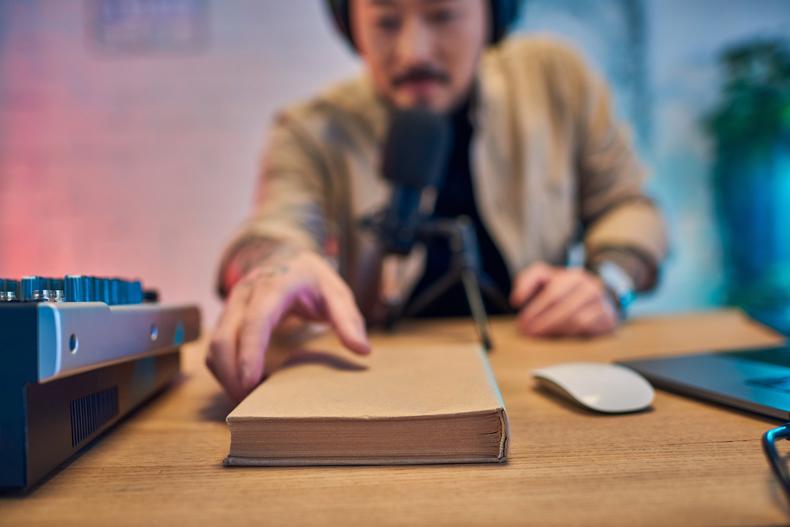
Audiobooks are typically recorded in a recording studio, though some more established audiobook narrators have their own setup to record from home.
The studio will have a soundproof recording booth with a mic from which you will record. There will be a sound engineer in the editing booth who will feed you instructions and redirection over your headphones. Sometimes there will also be a producer or director there to offer you redirection. Blackborow says this can either be “as you go or after each chapter.”
There are two ways to record an audiobook: “punch (or rock) and roll” or “fluff and repeat.” Which of the two you use will depend on how the sound engineer or production studio works. With “punch and roll,” the sound engineer is doing a basic edit as they go, so if you make a mistake, they will stop you, roll the tape back to the sentence before your mistake, and then feed it to you so that you can pick up the narration again from there. With the “fluff and repeat” method, if you make a mistake, you stop, pause for a second, and then repeat the sentence. This method means more work in the edit for the sound engineer, but is less time-consuming during the record itself.
A typical adult fiction audiobook is usually around nine to 10 hours in length, which Fortuin says “translates to two to three days of recording.” Torrens tells us that “most audiobook records work on a 10–6 p.m. timescale…[with a] full lunch break and usually two breaks a.m. and p.m.,” though you can always ask for more comfort breaks if you need them, to rest your voice or use the bathroom.
Fortuin recommends “wearing comfortable clothes, as you will be seated all day,” and try to avoid anything that will make too much noise when you move, such as jangly jewellery, as this will be picked up on the mic. Make sure you stay hydrated throughout the day to give the best results vocally. Apples make a great breaktime snack, because their high water content and slight acidity helps salivate your mouth, which stops you from sounding too dry, as well as cutting through any mucus buildup.
6. Grow your reputation
Many times, when it comes to casting audiobooks, the studios or publishers will book the narrators directly, rather than putting out a casting call. Often, they’ll look to those they’ve worked with before. It is important, therefore, to build good relationships and leave a positive impression with the producers and production studios you work with so they’ll want to book you again! As you add more audiobook narration to your CV, you can also reach out to more production studios and publishers, introducing them to your work.
The fees for narrating an audiobook are usually based on a per-finished-hour (PFH) rate. This means that you are paid for every finished, edited hour of the audiobook. So, if the contracted rate is £90 PFH and the final audiobook is 10 hours, you will receive a fee of £900. Remember that this fee will cover all of your prep time, the recording time, and also any pickups you have to go back in for (re-recording any sentences that need it).
Whilst there is no negotiated minimum rate for audio work from Equity, Fortuin says “most studios work with a standard minimum rate of £85 PFH, and up to £100 PFH for more experienced narrators.” She adds, “I would be wary of any studios offering less than this, because think about the hours of prep you are putting in.”
Blackborow cautions anyone starting out in this line of work who doesn’t have an agent to “protect yourself, check the contracts, and check what you are being asked to do for the fee.” For example, if you are recording at home, are they expecting you to do the edit for the fee as well? If they are, think about how that additional editing work will impact your overall hourly rate, and try to negotiate a better deal if need be.
Whilst Fortuin tells us that “audiobooks are the lowest paid area of audio work,” she also says “there is frequent work” recording them. For Blackborow, “It’s a joy of a job! I love it, and it can be so creatively fulfilling for actors in between other gigs.”