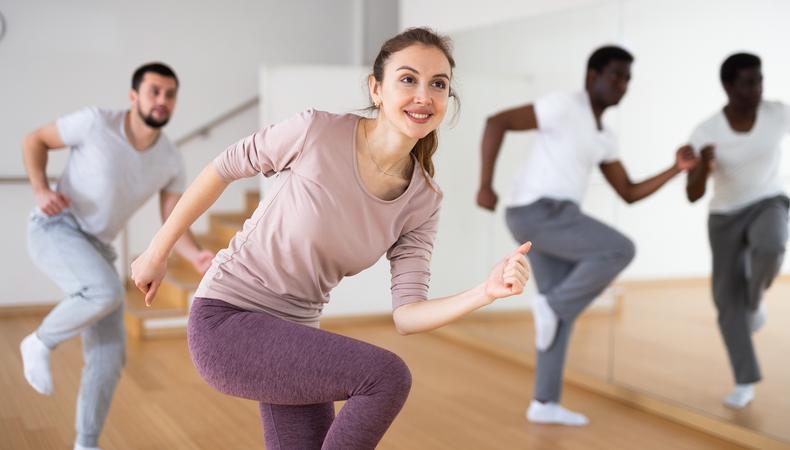
In dance, where artistry meets athleticism, mental and physical preparation are equally important. And good dance warmups should do both: bring the performer into a creative mindset and prime their muscles for movement.
Here, three dance teachers from the disciplines of contemporary dance, musical theatre, and ballet explain the benefits of warming up and some of their favourite preparation exercises.
According to dancer and movement teacher Marianna Sfyridi, a good warmup prepares “both body and mind” for the demands of rehearsal or performance. Sfyridi, who teaches her own movement practice called Circadian Bodies, which blends elements of contemporary dance and capoeira, says that a warmup “helps prevent injury, but also brings you into the present moment and connects you to the space and others.”
Lisa Ritchie, the head of dance at London drama school Mountview, sees warmups as “a moment of arrival – a chance to land, breathe, and listen.” She argues that “in many ways, the warmup is where the dance truly begins.”
She goes as far as to describe the preparation routine as “a sacred moment for the self,” adding that “it allows the dancer to feel strong, empowered, and ready – both physically and mentally.”
Ballet dancer and instructor Klaudyna Pawlicka says a warmup gently prepares dancers’ bodies and nervous systems for the challenges ahead, helping them feel “ready and confident right from the start.” That includes firing up the muscles by boosting blood flow to tissues – improving elasticity in preparation for jumps and turns, opening up the joints for better mobility and flexibility, and sharpening coordination.
Now that we know why warmups are important, let’s explore the components of a good one.
Of course, they can vary a lot among dance styles. “Ballet focuses more on alignment and articulated feet, contemporary on full-body and floor work, while street styles emphasise rhythm and groove,” Sfyridi says. “Some are structured, others more improvisational, but most build gradually from slow to more dynamic.”
Ritchie, whose focus is on dance for musical theatre, says physical preparation should focus on muscle strengthening, aerobic fitness, and technical readiness, while artistic preparation should connect to breath, ready the mind, and “cultivate the ability to listen, adapt, and create.”
For ballet, Pawlicka says flexibility, mobility, turnout, core, and glutes should all play a part. She favours active stretches and dynamic movements rather than holding static positions.
Pawlicka also stresses the importance of listening to your own body’s needs. A good warmup can “really ease that preclass stress or anticipation, letting us tune in to our bodies with focus and calm for safer, more joyful dancing,” she says.
Here are 10 warmup exercises for dance, recommended by teachers.
1. Sun salutations (surya namaskar)
These are a series of yoga poses with breath. There are different variations, but one is to begin in mountain pose, standing tall with your feet hip-width apart with relaxed shoulders and your arms by your side. Then gently raise your arms above your head while breathing in. Exhale and fold forward from your hips, letting your head dangle freely. Breath in and lift your torso halfway up, and then step back into a high plank position. You can then move through low plank, upward-facing dog, and downward-facing dog poses.
Ritchie says sun salutations help with grounding and breath awareness, centring the dancer physically and emotionally, releasing tension, and cultivating focus.
2. Spinal rolls
Begin standing. Slowly roll down through your spine, vertebra by vertebra, until your head and arms are hanging freely. Engage your hamstrings and back line of your body as you roll back up to standing. Repeat several times, maintaining breath awareness. Pawlicka says it can improve flexibility in the spine, release tension, and improve alignment.
3. Joint articulation
Make small circles through your ankles, knees, hips, spine, and shoulders. Make sure you do the same number of circles in each direction. It mobilises the joints and reduces risk of injury, Sfyridi says.
4. Rhythm and pulse activation
Sfyridi says this warmup exercise for dance involves light bouncing, shaking, or rhythmic patterns to the beat of music. Put on a song – perhaps in the genre you will be dancing to or something with a strong rhythm – and either lightly bounce up and down or shake out your limbs and body as a whole to the beat. The benefit, when done in a group, is to increase energy and improve communal timing and coordination.
5. Dynamic stretches and swings
Swing your leg in a controlled pendulum-like movement, front to back, for 10 to 15 reps, and then repeat on your other leg. You can do the same with your arms, either swinging them across your body or back and forth. Other dynamic stretches include lunges, arm circles, and twists of the torso.
Ritchie says this prepares the body for movement by gently increasing heart rate, blood flow, and muscle temperature. The exercises also “improve flexibility, coordination, and range of motion, while reducing injury risk,” she says.
6. Floor hip stretches
Pawlicka recommends that ballet dancers pay particular attention to their hips. There are many options for hip stretches, but one is a figure-four stretch: Sit or lie down, and place your left foot flat on the ground. Cross the ankle of your right foot over your thigh, and gently pull your left thigh toward your chest until a stretch is felt in your right hip. Repeat on both sides. The stretches help to increase the range of motion in your hips, which is perfect for executing extensions like arabesques.
7. Core activation
Perform several sit-ups or roll-ups with straight legs to engage your abdominals.
Pawlicka says this helps to improve articulation through the spine. It also develops core strength.
8. Dance technique exercises
Ritchie recommends incorporating ballet moves such as pliés, tendus, glissés, ronds de jambe, adages, and grand battement (both travelling and static). She says it ensures “continued growth in skill, strength, and confidence,” while preparing the body for the technical demands of dance.
9. Spatial awareness improvisation exercise
Sfyridi likes to get her students to move through the space they are rehearsing in with frequent, impulsive direction changes and variations in the level they are travelling at, such as moving through the space on tip-toes or crawling along the ground. She says it connects the body to the environment and sparks the participants’ imaginations.
10. Foot and ankle activation
Roll through your ankles or use an elastic resistance band for a targeted foot and arch warmup, Pawlicka says. Ankles are particularly susceptible to injury, so warming up their joints, as well as the feet, can increase stability.
This is just the tip of the iceberg, of course, and there are countless other warmup exercises and dance warmup games for groups, but this selection should give you a good starting point and may bring you one step closer to a career involving dance.