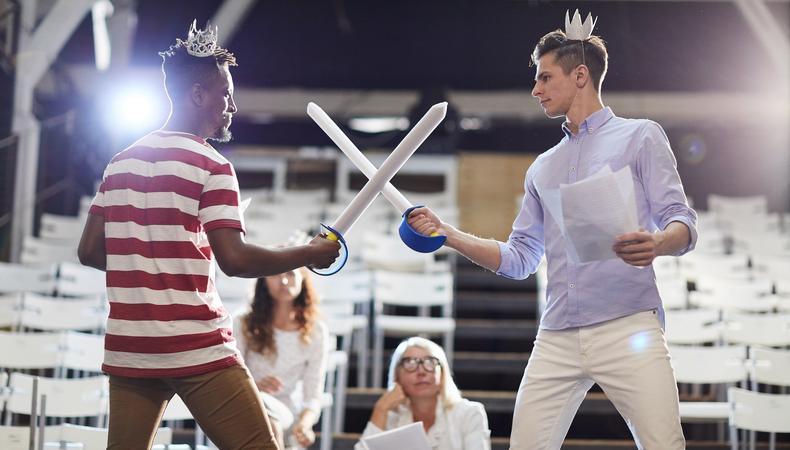
When you think of stage combat, perhaps you imagine an epic clashing of blades or a dramatic brawl with some heavy punches. But there are many other less obvious scenarios in which some combat choreography skills may come in handy.
“People often think stage combat mostly involves spectacular sword fights, big action sequences, brawls, and high-impact stunts,” says actor, stage combat teacher, and fight choreographer Zhenya Leverett.
But theatre combat appears in far more productions than you may realise. It can include “anything from a shove or struggle in a contemporary drama to a large-scale battle in Shakespeare,” Leverett says. Even actions such as “grabbing another actor’s hand, accidentally falling, or delivering a truthful physical reaction are all part of stage combat.”
War Horse at the National Theatre, The Hunger Games: On Stage at Troubadour Canary Wharf, Les Misérables at the West End’s Sondheim Theatre and infinite Shakespeare productions at the Royal Shakespeare Company are just some of the many theatre productions that feature fight choreography.
Fight, movement, and intimacy director Yarit Dor explains how stage combat skills may be taken into account during the casting process for a show. “You can’t make someone look like an amazing fighter in a short rehearsal period if they don’t already come with some skill set beforehand,” she says, arguing that this is particularly true for characters for whom “violence and fighting is part of their history.”
For those beginning an acting career, having stage combat basics on your acting CV may open doors to a wider variety of acting jobs.
JUMP TO
In a nutshell, theatre combat is “the art of creating the illusion of violence or conflict that should look believable to the audience while remaining completely safe for the performers,” Leverett says.
It’s a very technical craft, but it is about “much more than learning punches or sword fights; it’s precise physical storytelling,” she says.
Leverett, whose combat skills supported TV’s Killing Eve and who teaches at stage and screen combat training organisation ID Fight, argues that stage combat “isn’t just about fighting; it’s about acting.” It requires detailed script analysis, character work, and a “clear understanding of the emotional stakes of every moment.”
Fight director and actor Haruka Kuroda agrees. “It could just be a slap, but what makes the slap interesting is often what happens before and after,” she says. “I guide the actor to fine-tune those moments using their body, eyes, breath, and voice.”
When it comes to stage combat, safety is always paramount. For some moves, such as a stage combat punch, the “attacking” actor may not actually make contact with their scene partner, but the illusion is so convincing that it appears real to the audience.
And when actors do make physical contact, unlike in a real fight, it is all carefully controlled through choreography so no real harm is inflicted.
Some of the basic unarmed stage combat skills include punches, slaps, falls, grabs, and kicks. You may also learn the foundation for a particular weapon, such as a broadsword, dagger, knife, or firearms.
Alongside these specific techniques are “core principles that apply throughout,” Leverett says.
“One of the concepts, for example, is understanding the difference between contact and noncontact techniques, how to create convincing illusions of impact, and how to do so safely while maintaining the level of aggression and intensity the story requires,” she says.
Leverett adds that actors also develop their timing, spatial awareness, reaction, and communication skills through learning stage combat.
However, the greatest challenge, she says, is “combining technical precision with emotional truth.” In the heat of the moment, “important details are forgotten and safety can be compromised,” which is why continual practice to make safe techniques second nature is important.
Other essential components of stage combat, according to Taka Strike Club, include learning choreography, with a “good fight scene [resembling] dance” in the sense that the actors are telling a story through choreographed movement and physical awareness, which involves “an acute understanding of body positioning and balance” to prevent accidents.
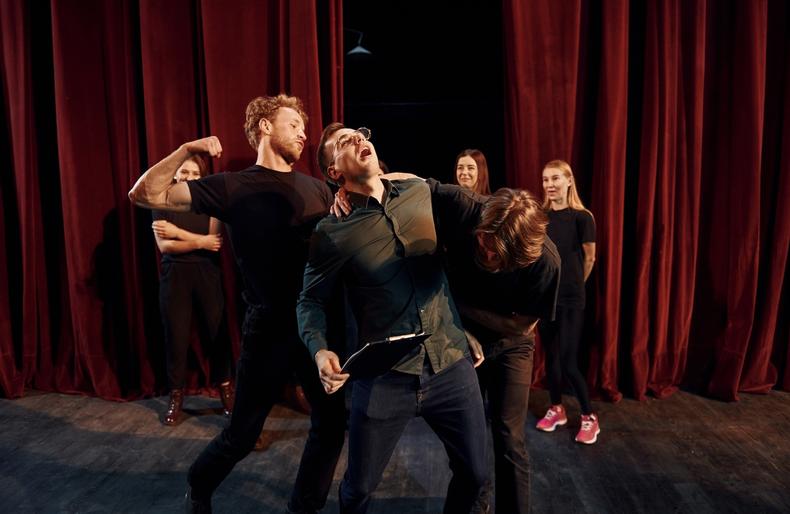
Credit: Standret/Shutterstock
Many mid- and large-scale productions that involve stage combat choreography of any kind will have a fight director.
Also known as a fight choreographer, this person is responsible for overseeing all facets of combat scenes onstage, with a focus on making the fight realistic and ensuring the safety of actors.
Why would you need a qualification if there is already a professional on hand to choreograph the fights?
First, fight directors will work with the skills of the actors at hand. The more skills you have, the more scope they have to include advanced or nuanced choreography.
Second, practice makes perfect. Stage combat isn’t a skill you can learn overnight, but if you already have the basics, then you’ll have a stronger foundation to build your performance upon.
Third, when you’re getting started as an actor, learning how to do stage combat may help you safely execute physical moves in smaller productions that do not have a fight director. Of course, never do anything you feel remotely unsure about or that could be unsafe. You can always tell the director that you need professional support.
When seeking training in the UK, Leverett recommends working with an accredited organisation such as the British Academy of Stage and Screen Combat (BASSC).
BASSC offers 10 disciplines, from unarmed combat to working with a range of weapons; each certification includes 30 contact hours. Organisations that offer BASSC courses include ID Fight in London, Stage Fight Scotland, and many major drama schools.
“The value of a certification course isn’t just the certificate you receive at the end. The process itself is what matters,” Leverett says. “By the end of the course, you create and perform a complete fight scene with acting, character, and storytelling. It’s two things in one: learning the physical skills and learning how to use them as an actor.”
If this article has convinced you to give stage combat a try, here are three tips for approaching it.
1. Prioritise acting.
“One of the biggest things actors can overlook is focusing entirely on the trick – making the slap or punch look convincing – but forgetting to complete the illusion through their acting,” Leverett says. “If neither character truthfully experiences the emotional and physical consequences of the violence, the audience thinks, ‘That was a good stage combat slap.’ Instead, you want them to think, ‘What?! I think she just really slapped him! What’s going to happen now?’.”
2. Always warm up before rehearsal.
In the same way you would warm up your body before any kind of exercise, it’s important to do so before a stage fight. “Stretching reduces stiffness and prepares muscles for intense action,” according to Taka Strike Club.
3. Train consistently.
The more you train, the stronger technical foundation you will build, Leverett says.
“Strong technical foundations give you the freedom to perform choreography safely, truthfully, and confidently, allowing you to focus on the story rather than worrying about the mechanics,” she says.