
Have you ever seen a play in which an actor’s movement looked odd and seemed to have no real purpose behind it? Have you spotted a continuity error in a film? These are both examples of bad blocking. When blocking is done well, on the other hand, you probably won’t notice it at all – and instead you’ll be drawn into the storytelling.
What exactly is blocking in drama, and why do actors need to know about it? Here is a handy guide, with insights from directors working across stage and screen.
JUMP TO
In a nutshell, blocking describes the “the placement and movement of actors, and the choreography of physical action,” says stage director and dramaturge Ed Madden.
When you become an actor and land your first theatre or film job, thinking about your positioning on stage or camera is essential – and one of the basic components of theatre or screen performance.
Blocking on stage encompasses everything from choreographed fight or intimacy scenes to entrances and exits and the placement of actors in relation to one another, scenery, and props. Without blocking, a performance may be “chaotic and difficult to follow,” according to Theatre Haus.
“Blocking is often one of the first things you do as you get a scene on its feet,” says stage director Joe Gilmour. “It is the act of positioning actors around the stage and deciding when in the scene an actor moves in order to give a rough shape to the story of that scene.” Actors then add detail with their physical and vocal performance, which is when “the scene comes alive.”
Blocking in film is all about the position of the actors in relation to the camera, and it includes everything from actors’ gestures to hitting a mark correctly.
Madden, whose directing credits include Sarah Power’s Welcome to Pemfort at Soho Theatre, argues that blocking is a somewhat “clunky” word. Director Jenny Sealey – the artistic director of disabled-led theatre company Graeae – agrees, preferring to use the term “choreography,” since “all theatre is choreographed, but not necessarily with the same precision or discipline as dance.”
Regardless of how you prefer to describe it, there are many reasons blocking in drama is important.
- To establish relationships between characters: “Imagine how differently the same scene between two characters might play with the actors standing at opposite ends of the space, or close enough to touch, or one laying their head in the other’s lap,” Madden says.
- For safety reasons: Blocking also plays a critical role in ensuring the safety of the actors, preventing collisions and accidents on stage.
- For technical reasons: Blocking also helps the lighting designer know which part of the stage to illuminate, or, onscreen, ensures that the desired framing of a shot is achieved.
- Storytelling purposes: Good blocking helps move the narrative forward. “Movement tells the story as much as dialogue,” says screen director and writer Oz Arshad, who co-hosts The Directors’ Take podcast. “Humans move when they’re uncomfortable or defensive, when they’re avoiding something or pursuing it.”
The two vary “hugely,” says director Amy Hodge, who works across both stage and screen, and has taught directing in drama schools.
The biggest difference with blocking for film is that it is “uniquely precise,” according to StageMilk: “Theatre blocking has its own technical requirements – finding your light, not upstaging people.... But film is planned to the [nth] degree to accommodate cameras, the lighting, and the limitation of sound recording.”
Some stage shows may have less prescriptive blocking, while others – especially musicals and productions with large casts – are often more strictly choreographed.
In film, it is also essential to consider continuity across multiple takes that will be edited together. “If you pick up a glass with your left hand in the wide [shot], you have to pick it up the exact same way in the close-up,” StageMilk explains. “Otherwise you start having props and costumes and bloodstains flying about from shot to shot.”
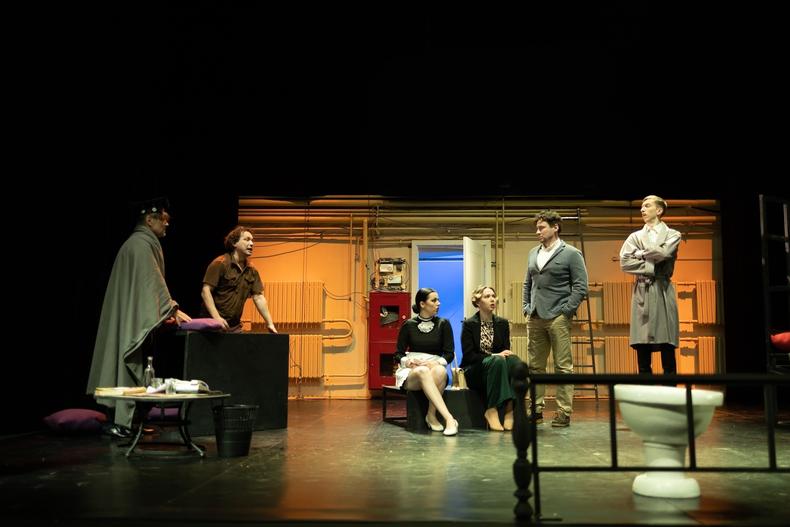
Credit: Kozlik/Shutterstock
The process may vary widely from one director to the next. Some directors may be very prescriptive about blocking, but many are interested in input from the actors and prefer a more collaborative process.
That is the approach Arshad takes. “I might have milestones in the scene that I know are important visually or structurally, but how the actor gets there is up to them,” he says. “Other times I’ll just run it and watch what feels natural. If they instinctively move, I’ll lean into that.” More specific entrances, exits, or stunts will be “more precise and rehearsed,” but Arshad says he otherwise wants “blocking to come from behaviour.”
Gilmour takes a similar approach onstage, using the actors’ instincts as a starting point. “Being overly prescriptive with where an actor moves can sometimes restrict the actor’s instincts, and they focus more on reproducing what you’ve told them to do than connecting with the situation and their scene partner,” he says. He explains that the job of the director and actor is “to create believable behaviour onstage.”
Hodge says it depends on the material. “In a play, action often blocks itself if you allow it to emerge from the emotional truth of the scene and the logic of place,” she says. She adds, however, that moving logically within a scene involves taking into account the design elements of the production, such as where the entrances and exits are positioned.
Blocking is something that may evolve throughout the rehearsal process, as actors become more familiar with their characters and directors refine their staging, but it typically becomes fixed eventually. “At the start of any production, I give actors complete free reign to explore, to chop and change until something physically and emotionally settles,” Sealey says. Eventually things have to be set, because “the lighting gets set in the tech and that becomes the playground in which the world of the play lives.”
In Mischief Theatre’s long-running West End production, The Play That Goes Wrong, the actors frequently collide with the scenery and clumsily end up in each other’s way. It’s all deliberately done for comic effect, gleefully demonstrating to their audience what bad blocking taken to the extreme could look like.
But bad blocking does not have to be quite so explicit to have a detrimental impact on a production. “Bad blocking is when you enforce it and it comes off unnatural for actors,” Arshad says. Hodge agrees that “bad blocking pulls you out of the world” of the production. Some other examples of bad blocking on stage include an actor upstaging – or masking – another actor during an important moment, and random fidgeting or movement that distracts from the main focus of the scene.
Good blocking, on the other hand, “is seamless and not obvious,” Sealey says. Hodge agrees. “Good blocking in a play is not noticed unless the production wants you to be aware of it,” she says. “As a consequence of good blocking, the audience is free to be immersed in the emotional logic of a scene and the story is completely clear to them.”
Madden adds that good blocking “communicates something,” whether about a character, a relationship, or the play’s point of view.
1. Know your lingo: For stage acting, that includes knowing stage left from stage right and upstage from downstage so you can navigate the space. Onscreen, it includes knowing the difference between a close-up, medium shot, and wide shot so you know how much of you will be visible in shot.
2. Make notes on your script with a pencil and eraser: Blocking may change over the course of rehearsals!
3. Be flexible to different approaches: There’s more than one way to block effectively, and different directors will have different approaches. Be prepared to adapt your process accordingly.
4. Trust your instincts: Bring your own judgement and ideas to the rehearsal room.
Movement and positioning onstage is one part of a wider task to appear as a “real, fully rounded human being on stage,” Gilmour says. “If you can do this and still seem like a real person, you’re doing your job as an actor!”