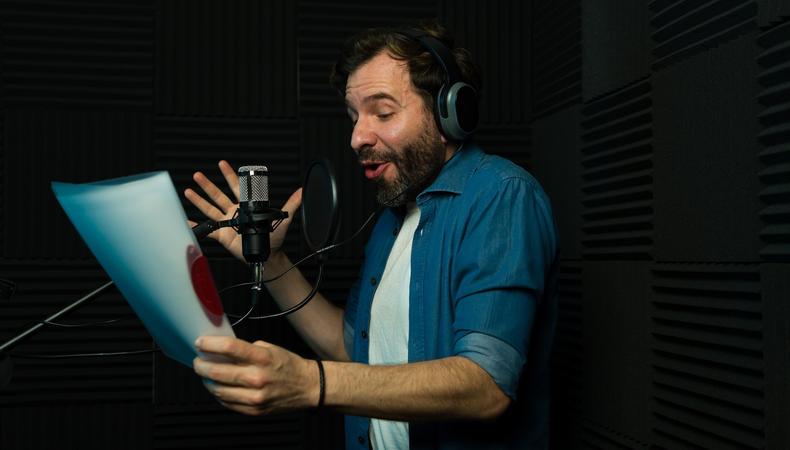
Ever been told you have a knack for impressions, an aptitude for accents, or simply a strong, clear, and appealing way of articulating things? If you’re also comfortable reading out loud, voice acting could be your calling – whether as a supplement to traditional acting or a career in its own right.
There are voice-acting opportunities in everything from corporate videos to podcasts, but competition is fierce and success depends on mastering more skills than you might expect. Here’s a breakdown of how to become a voice actor in the UK.
JUMP TO
Voice actors work in the audio sphere and are employed to play characters, tell stories, or provide information, using only their voice to do so. There’s a varied amount of voiceover work available, including:
- Advertising
- Animation
- Announcements
- Audiobooks
- Corporate videos
- Dubbing foreign language content
- Educational videos
- Podcasts
- Video games
Some voice actors specialise in one or more areas, while many pick up work in all of them.
“Wherever you are,” says seasoned voice actor Jo Pickard, “there is somebody who is a voice actor to whom you will be subconsciously listening.” It could be while on hold on a phone call, watching a children’s TV programme, or simply hearing a voice on the train.
1. Consider voice-acting training.
Even if your voice is a natural fit for a career in voice acting, chances are you’ll benefit from sessions with an experienced voice coach.
You’ll learn important performance skills, like how to convey emotion, enunciate clearly, and project your voice, and you’ll receive advice on everything from warmup routines to important breath work.
2. Take acting classes.
It’s called voice acting for a reason. Even if you’re providing the voiceover for an advert rather than voicing a character, acting skills are useful for the job.
As noted by David Carling, whose voiceover clients include Jaguar, Smarties, Royal Mail, Walkers, and M&S: “I’ve always approached voiceovers as an actor’s character work. From the stuffiest of corporates to huge cartoon voices.”
Voice actor J.B. Blanc – who’s voiced more than 400 characters in animations and video games, including Kung-Fu Panda, Scooby-Doo, Fortnite, and Call of Duty – concurs, describing his drama school training as “the single most important reason for the length of my career.”
You don’t need a full drama degree; even a few local or online acting classes can help you portray different characters and emotions.
3. Get comfortable on the mic.
Hone your talent by recording yourself reading scripts, books, articles, and adverts, then listen back to identify areas for improvement. Tone, clarity, and enunciation can progress leaps and bounds after a few sessions – above all, you’ll sound progressively more natural and relaxed.
Practice is also about becoming a pro with the mic. Professional equipment can be quite sensitive, so work on:
- Speaking around 5 inches from the microphone
- Flipping script pages silently, away from the microphone
- Avoiding wearing anything that might make a sound
- Moving slightly to the side when you use sibilance (“s” sounds) or plosives (hard “p” sounds)
4. Volunteer.
Booking work as a newcomer can be tough – and paid work may be a long time coming. However, volunteering is a chance to get experience and potentially pick up some demo material. Contact the following organisations in your area to see if they are in need of a voice actor:
- Local businesses and charities
- Schools or libraries where you can read to children
- Hospital and local radio stations
- Organisations for the blind
That’s how experienced audiobook narrator Simon Vance got his start. “I stumbled upon the RNIB (Royal National Institute for the Blind) Talking Book Service…I spent about one afternoon a week recording books for the blind and partially sighted to listen to on special machines. There was a little travel money, but that was it.”
The work paid off. Using snippets from these recordings as the basis for his demo reel, Vance began booking paid work, and he has since narrated more than 800 audiobooks, from The Wolf of the North trilogy to Great Expectations.
5. Make a demo reel.
Unless you already happen to be an A-list actor, having a reel is essential. The demo reel is a series of short audio clips showcasing your work for prospective clients or agents. Using clips from previous gigs is ideal (so long as you have permission), but those lacking professional experience can simply read relevant copy aloud.
Create a strong demo reel by:
- Being brief: ReelCrafter recommends a reel of 90 seconds, broken into 15–20 second segments, or up to five minutes for narration demos.
- Showing your vocal range: Showcase the accents, ages, and vocal types you’re able to deliver.
- Covering all categories: Include commercial, narrative, character, gaming, and animation demos, in that order. “Most voice agents will be interested in your commercial reel first, your narrative reel second, and any character reels third,” writes London-based voice reel producer Kirsty Gillmore.
- Sounding professional: Your demo should sound professionally produced and polished. “I know that £50 reel looks tempting,” writes Gillmore, “especially if you’re fresh out of drama school or you’re going through a dry patch, but don’t just leap on the cheapest deal you can find.” For reference, at the time of writing, the recording company Voice Reels charges £674 for its Starter Package, while Create My Voice Reel charges £797–£822 for its equivalent.
- Being yourself: Clients want you to sound natural, so resist the temptation to imitate famous voices or speaking styles that you assume they’d prefer.
6. Build an online presence.
While a career in voice acting takes place behind a mic, it’s important you get your name (and voice!) out there in order to book work.
- Create a website. Use a simple platform like Wix or Squarespace to showcase positive client reviews, previous work, and your demo reel.
- Display your talent. Create an Instagram, YouTube, or TikTok account and add your own content. For example, many YouTube Short creators find their following by reading interesting stories they found on Reddit. At the very least, it’s an opportunity to practice voiceovers on a public platform.
- Build a network. Contributing to online groups and communities can lead to recommendations or tips for future work, and a profile with many followers or connections provides social proof for potential clients.
7. Get a voiceover agent.
Casting directors typically find talent through agents when it comes to casting the crème de la crème of acting jobs – and voice acting is no different. For voiceover work, it’s worth signing with an agency that specialises in voice acting, such as Soho Voices, Just Voices, The Joneses, or Advoice.
Do some research, create a list of agencies you’d like to contact, then draft an intro email outlining your voice-acting experience and goals. You should also include a link to your demo reel and acting CV.
Don’t assume calls for a meeting indicate a sealed deal. Demos may get you in the door, but agents typically expect you to audition in person. Arrive professionally dressed and ready to work those vocal cords.
8. Start applying for roles.
Agent or no agent, you can look for voice-acting work yourself. Reach out to companies that employ voiceover talent via email, sending over your demo reel and CV with a note on why you’d like to work for them. Online marketplaces for freelancers, like Fiverr and online job boards, are other places to find work.
9. Create a home studio.
It is increasingly common for voice actors to work remotely – and many companies expect talent to have access to a home studio. If you’re serious about voice acting, and confident you’ll book work, invest in recording equipment and soundproof a small office or even a large cupboard where you can record material. You don’t have to spend thousands of pounds to do this. “Don’t let anyone tell you that if you don’t spend six months researching, building, and spending a fortune on an optimal studio, you can’t get started,” warns long-time voice actor and vocal coach Richard Cotton. “You can, and it’s simpler than you think.”
You’ll need:
- A professional condenser microphone
- Audio interface
- Professional headphones
- A pop shield
- A quiet recording environment (try adding sound-absorbing foam panels to the walls, window inserts for each of your room's windows, and soundproofing mats on the floor, then hang acoustic blankets from the ceiling to create a soundproof room-within-a-room)
- Speech clarity: Each word must be crystal clear without sounding over-articulated or unnatural – getting the right speed and level of enunciation is key. You must also avoid the mouth noises many of us make unconsciously, such as swallowing saliva.
- Consistency: Everything from pace to energy should stay consistent through each recording to save on time and avoid additional takes.
- Technical skills: You needn’t be a sound-mixing wunderkind, but a grasp of audio-editing basics can prove an asset, especially if you’re expected to edit your recording yourself. “You work with clients a lot of the time that don’t have an audio team,” says voice actor Elliot Hardman. “They really appreciate having somebody on hand…who can do the voiceover and also the mixing at the same time…that definitely helped me a lot.”
- Professional approach to health: Your voice is your instrument, so treat it well. Don’t smoke, stay hydrated, avoid whispering or shouting, and rest your voice between jobs.
- Adaptability: Focus is important, but don’t close yourself off to fresh opportunities. “When I started out, I never dreamed (if anyone ever does) that corporate explainer videos would be one of my biggest sources of work,” says experienced voice actor Christopher Tester. “But once I did, it became a key focus as an income stream.” The ability to switch from voicing video game warlocks to providing voiceovers for corporate videos (and vice versa) broadens your reach and helps avoid dead ends and dry spells.