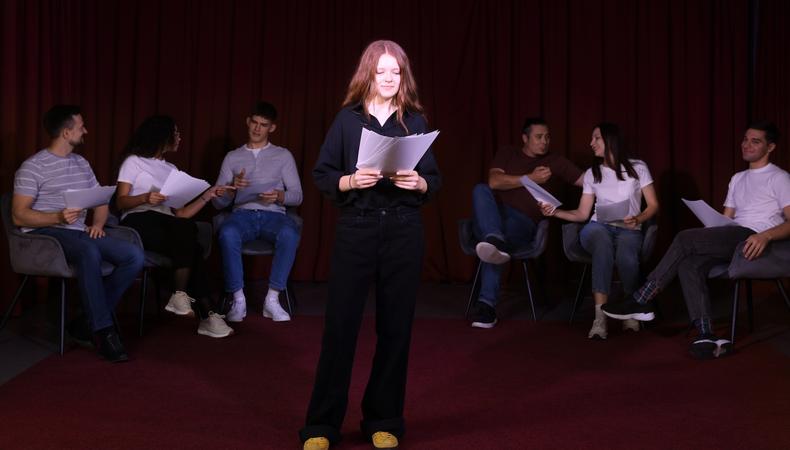
Being given a script with the expectation of performing it on the spot with no form of preparation is a nightmarish prospect for many actors. Being asked to attend a cold reading certainly has its challenges, but there are ways that you, as a performer, can dispel the fears commonly associated with it. From reading out loud to improvising, here are some tips.
JUMP TO
In the context of the acting industry, a cold reading is essentially an impromptu read-through of a script that none of the actors have seen before. The process involves receiving your sides immediately before your audition, with no preparation at all and often no knowledge of the material. It can be a nerve-racking experience. Practice and a good attitude, however, will see you through.
Cold readings are often the result of a director or a producer wanting to see more of a certain actor. This said, other elements could come into play:
- There have been overnight rewrites.
- Improvisation is necessary for the role you’re being auditioned for.
- They want to test an actor’s ability to adapt and think on their feet.

Credit: Pixel-Shot/Shutterstock
Regardless of whether the cold reading is happening at an audition or you’re doing the first reading of a new play, the process is more or less the same.
- You will be welcomed into the room, where you will receive your sides and a few instructions.
- Depending on timing, you may be given a few minutes to look through the script and get a rough idea of the material you’ll be performing.
- You will be asked to act through the scene, either alone, with another actor, or with a reader.
It’s worth mentioning that you probably won’t be expected to go through an entire screenplay, only a few lines or a few pages (unless you’re being called to do an entire read-through).
A cold reading allows the production team to gauge how a performer works under pressure. The casting panel will not only evaluate how well you deliver your lines, but also keep an eye out for any hesitations. Your attitude will be put on the spot, as well as your intellectual flexibility and disposition toward the challenge. The lack of preparation becomes a useful tool for the director, who will be able to assess whether their vision for the character aligns with the performer’s. It can also give the director a sense of how a performer will react to last-minute changes to the shooting schedule.
You’ll always be heading into a cold reading without prior knowledge of the script, but there are ways an actor can circumvent the hurdle. These are our top tips for mastering cold readings.
Practise out loud
Being comfortable reading out loud is crucial here. You can use any piece of writing to practise, starting from a story you already know and building up to reading something you’ve never seen before. You can’t prepare for a cold read, but you can demystify the process and familiarise yourself with the experience so you’re comfortable with the act of reading unfamiliar material when the time comes.
Learn to skim a text
Since you’re not acquainted with the script, learning to skim a text quickly – scanning for major moments or emotional shifts – right before you’re expected to read will ease the outcome. Having even an inkling of an idea about what comes right after your current line informs your performance and allows you to build your character on the fly. Knowing what to look for in a scene makes skimming it slightly easier. Here are some pointers:
- Identify the setting. You sound different if you’re in a library as opposed to a loud bar. Should the setting impact your delivery?
- Meet the emotion. Try to isolate any information regarding the emotional side of your character. The dialogue may laterally provide you with context clues regarding their state of mind. Are they angry or relaxed? Do they seem worried or happy?
- Focus on the bigger picture. You’re not expected to land the details of your portrayal at this stage. Make bold choices based on the information in front of you and follow your performing instincts.
Use your body language
Try to look down at the text as little as possible. Keeping your copy at eye level will allow you to keep your posture upright and look the casting panel in the eye. Position yourself so you can engage them directly, because it will help you establish emotional connection. Let them see what you can do and use your physicality to communicate your inner world. Relax and release the tension you’ll most likely be feeling before you start your scene. Ideally, you’ll want to avoid showing any signs of nervousness, so focus on your breathing and pay attention to how hard you’re gripping your script.
Avoid rushing
You may be tempted to rush your lines so you can be over and done with it, but you’ll risk coming off as rattled if you do. Take your time, let your scene breathe, and let your character settle. Remember that pausing and listening are fundamental skills for an actor. Use silence to your advantage; it’ll buy you a moment to think and plot the delivery of your next line.
Give yourself permission to experiment
Cold reads are not about perfection, and you won’t be expected to deliver the script without errors. If you fumble a line and get lost on the page, it will be OK. Be open to feedback and listen closely to what the director and production team have to say about the character and the project as a whole. They’re not there to trick you into failure, but to help you reach your full potential. Stay in character through your missteps and take it on the chin. It’s normal to stress over your performance once it’s done and mourn the choices you did or didn’t make; it’s a byproduct of a cold reading. Remember: A bad cold read is simply a stepping stone to a better one.