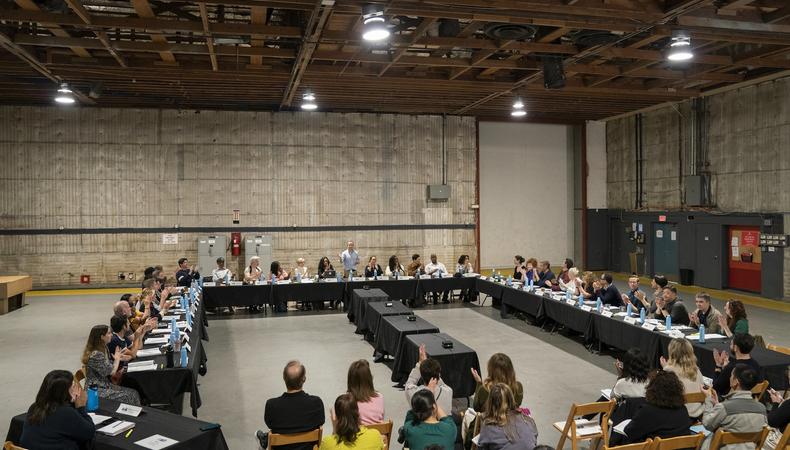
You’ve applied for a job, aced the audition, bagged the role, and read the script. Now it’s time for the table read. It’s usually the first time the cast and creative team get together on a project – either in theatre, film, or TV – so a table read can feel like a big moment. You’ll often be meeting new colleagues and sowing the seeds of collaboration for the job to come, as well as hearing the script out loud and in person for the first time.
But what exactly is a table read, and what’s expected of an actor at this stage in the process? We break it down for you.
JUMP TO
Also known as a read-through, the clue is in the name: It’s when actors and the creative team sit around a table to read through a script together. In today’s industry, that table could be virtual, with a read-through happening via video call. But, traditionally, it’s an opportunity to get everyone together in person to hear the script out loud, with the full cast, director, writer, producers, and heads of departments usually in attendance.
Nerves are normal, but even for brand-new actors, there’s no need to be intimidated by a table read. They often feel loose and informal, and, although you want your performance to impress, no one will expect you to have memorised the entire script or to have a definitive interpretation of your character yet. A read-through is more about getting a sense, as a company, of the script: the story, the characters and how they relate to one another, the pace and feel of the work, and any changes that need to be made to the script.
Rehearsals for plays involve putting a script “on its feet” – exploring blocking choices and different interpretations of lines or scenes. Filming, on the other hand, requires fully realised sets, costumes, and performance choices. But a table read is the first step on both of those journeys. Such meetings usually take place in a rehearsal studio for a theatre production, in a production office for film and TV, or even virtually via a platform like Zoom. The actors, like everyone else, stay seated the entire time.
Most table reads begin with brief introductions or icebreakers, since many people in the room are likely meeting for the first time. A director may set out their vision for the project, and will likely lay out the basics of how the read-through will go. Once introductions are done, the script is read out loud.
Everyone will have their own copy of the script, and actors will read their parts directly from it. A director or an assistant may read scene descriptions and stage directions. The focus is on reading with clarity and presence, rather than giving a full theatrical performance.
You can also expect that the reading may halt at points, usually between scenes or in places where there is an obvious break. That gives everyone a chance to ask questions or to discuss elements of the script or performances. Writers will take notes, directors may share feedback or ask for clarifications from the writer or actors, and actors get to ask questions or share their insights on how it is reading.
How much in-depth discussion is appropriate in a read-through can vary between TV, film, and theatre, and between different creative teams or projects. Take your cue from the director, who should make clear the parameters of the read. If in doubt, just ask about what level of feedback they would welcome at this stage.
How long is a piece of string? The length of a table read depends on the length of the script and how much discussion happens along the way. For most feature-length scripts, a table read can range from two to four hours, while a single TV episode may take only an hour or two. Similarly for theatre, it’ll depend on the length of the play. A read-through on the first day of rehearsals may take most of a morning or afternoon.

Credit: megaflopp/Shutterstock
The table read is a vital element of preparing for a shoot or kicking off a rehearsal period. For a writer, who may have been crafting a script alone at their computer for months if not years, it’s a chance to finally hear their words spoken out loud by professionals who may bring exciting new or unexpected ways of delivering the lines.
It’s also a chance to hear what’s not working so well, to identify any missing plot beats or unclear moments, to spot what feels repetitive or redundant and could be cut, and to make sure each character has a satisfying arc.
A read-through is also an essential opportunity for the writer and the creative team to hear how the script literally sounds – if the dialogue flows or zings between characters, if their voices sound natural and authentic, if scripted jokes land when spoken out loud – and to assess the pace of script. How long do scenes actually take? Is the pacing within and between scenes working, or does it feel rushed or sluggish? Does the tension dissipate at any point? Are there longueurs during which it feels lacking in action, conflict, drama, or humour?
A writer will take notes and may redraft a script as a direct result of things that popped up during the read-through. In extreme cases, a project may be postponed for major rewrites and recasting.
For an actor, a table read is mostly about getting to know your costars and the creative team. It’s a low-pressure way to begin to tune into one another’s rhythms and performance styles and get a feel for everyone’s personalities and approach to the job. It can also give you a much more 3D and holistic understanding of the script and your character’s place within it.
A table read shouldn’t be intimidating; see it as a chance to forge connections with your costars. But all first meetings can be a little nerve-racking, so here are some tips for actors on how to prepare for the best table read possible.
Bring the essentials
Pack your script, a pencil, a rubber, and a highlighter for taking notes on your script, plus a notebook for big-picture thoughts or for keeping track of questions you want to ask or things you’re unsure of. And bring a big bottle of water so you can stay hydrated!
Read the script thoroughly – several times
You don’t need to be off-book, but having a decent grasp of the script before you sit down is a very good idea. You should know who your character is, and have a sense of their context, backstory, and relationships with other characters. Preparation helps you read with confidence and presence, and it’ll mean that any questions you have genuinely need to be asked.
Make eye contact
You’ll be reading from a script in your hand, but don’t forget to engage with your castmates. Look at your scene partners when you can, especially in moments of high tension. Eye contact can give even a first read-through extra charge, and it helps directors feel the chemistry in their cast.
Perform, but don’t overdo it
You’re there to act out the script, but no one is expecting a polished scene. At this stage, clarity and simplicity are valued over high-octane theatrics. Commit to your character and their emotional arc, though, since you want to prove you’re right for the part, not just reciting the lines. (A poor table read could lose you the job in a TV show or film.) All that said, this isn’t a moment for showboating. Save major physical or dramatic choices for rehearsals or shooting, unless the director explicitly invites you to explore them. No flappy hands or table-top death throes, please.
Make notes
A table read isn’t just performance; it’s research. Be ready to jot down insightful comments from the writer or director, and any thoughts on your character that get discussed or that occur to you. Or simply note down places where you want clarification, so you can raise them when the time comes.
Ask questions
If you’re unsure about your character’s motivation, the meaning of a line, or the significance of a detail in the text, table-read discussions are an ideal moment to ask. Coming with questions or joining in discussions shows you’re already thinking deeply about the part and you’re open and curious in the creative process. That’s not a bad first impression to make on writers, directors, or fellow actors. Just think carefully about when to ask your questions; you don’t want to interrupt a colleague midflow.