
When it comes to starting a career as a professional dancer, writing a dance CV may not be the thing you’re most excited about. It may even feel a little daunting if you don’t know where to start.
Having a dance curriculum vitae is, however, a vital step toward putting yourself out there and applying for dance jobs. You’ll typically have to send one in order to land an audition.
It will differ depending on the type of work you’re applying for, but for live performances or dance shows in a theatre, “they’ll ask for the CV straight away, usually with a showreel and maybe an expression of interest statement or video,” says contemporary dancer and choreographer Ruby Portus.
For more commercial work, however, it’s less likely that you’ll be asked for a CV for all casting calls, Portus says. Instead, dancers are often asked to provide a headshot and sometimes an Instagram handle and to fill out a form, followed by a self-tape for the second round.
JUMP TO
What should you include in your dance CV (or dance résumé, as it’s also known).
It’s essential to have the headline information – your name, a headshot, and your contact information – clearly visible and toward the top of the page. It can also be useful to include a short summary of your experience in a few sentences near the beginning, as well as physical attributes such as your height and hair colour.
Then you can list your credits, training, and other skills, usually in that order, but that may vary among CVs. Portus says that she and her dancer friends divide their credits into categories, such as live show performance experience and commercial work.
If you’re lucky enough to have won any awards or scholarships, you should make sure you list those too. It’s also worth including any other nonperformance but dance-related jobs, such as choreography, because those skills may come in handy for a performance job.
If you have any other skills at all – whether it’s playing an instrument or a particular sport – Portus recommends including them in a section at the end, because you never know when a production may be looking for one of those specific skills. Bring It On: The Musical is about cheerleading, for example, so musical theatre dancers with gymnastics or cheerleading on their CV may have a better chance of landing the role, especially if casting directors are choosing between two equally strong auditions.
“I’ve got a [section in my CV] for miscellaneous other skills,” Portus says. “I used to play the flute and I’ve got ‘flute to this level,’ unicycling, scuba diving – all of the random things that could be helpful. Basic French, singing, and stuff like that. Maybe you’ll never use those things, but I think even if [casting directors are] not looking for those specific qualities, it can be quite attractive to them to see that you’ve got loads of different skills and you can adapt and you’re excited to learn stuff.”
When it comes to formatting your dance CV, Portus says that it should be “formatted clearly” in a way that prioritises making the information accessible, but don’t worry about doing anything too fancy.
She says that when she has auditioned dancers in the past, sometimes “there’s a lot of effort put into highly formatted CVs,” but she prefers to stick to a simple format to get the information across in a concise way – “a bullet-point list, basically.”
1. For performers
Dancer Claudia Dean has shared a dance CV template, and explained how she put it together.
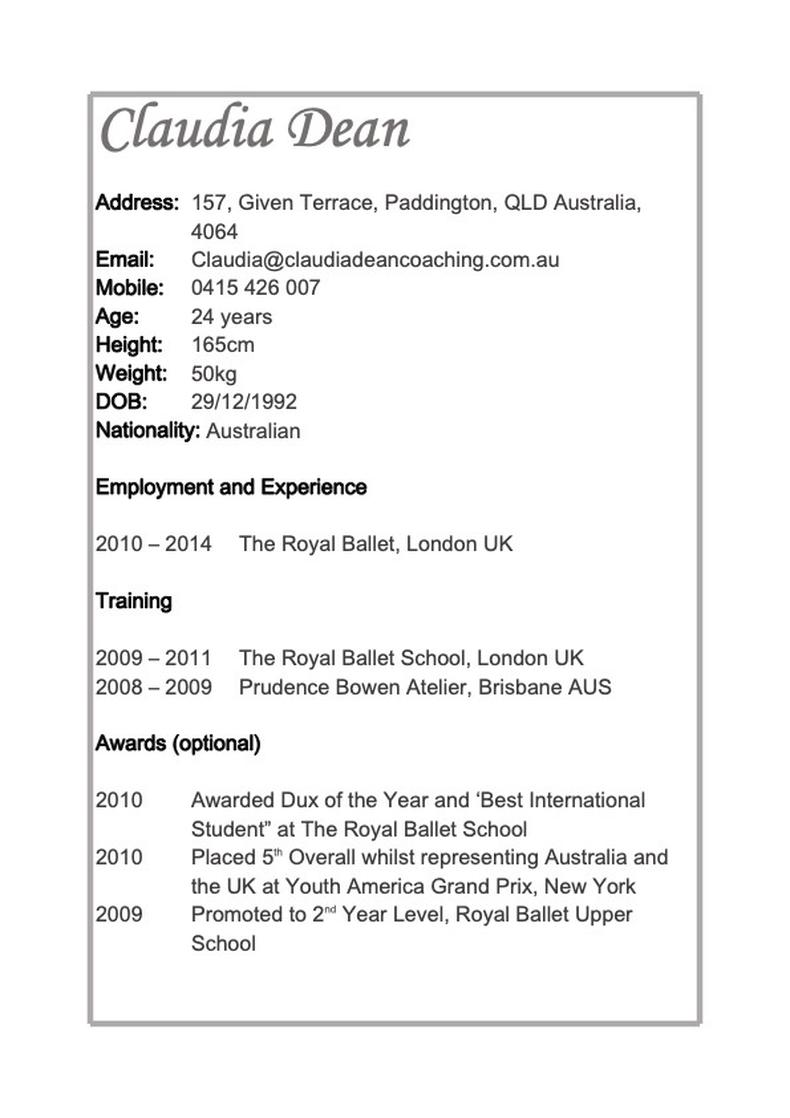
It includes the key information at the top, followed by employment and experience, training, awards, and repertoire performed.
2. For dancers applying to a training programme
The USC Glorya Kaufman School of Dance in Los Angeles has shared a dance CV template for dancers who are either applying to or are in training.
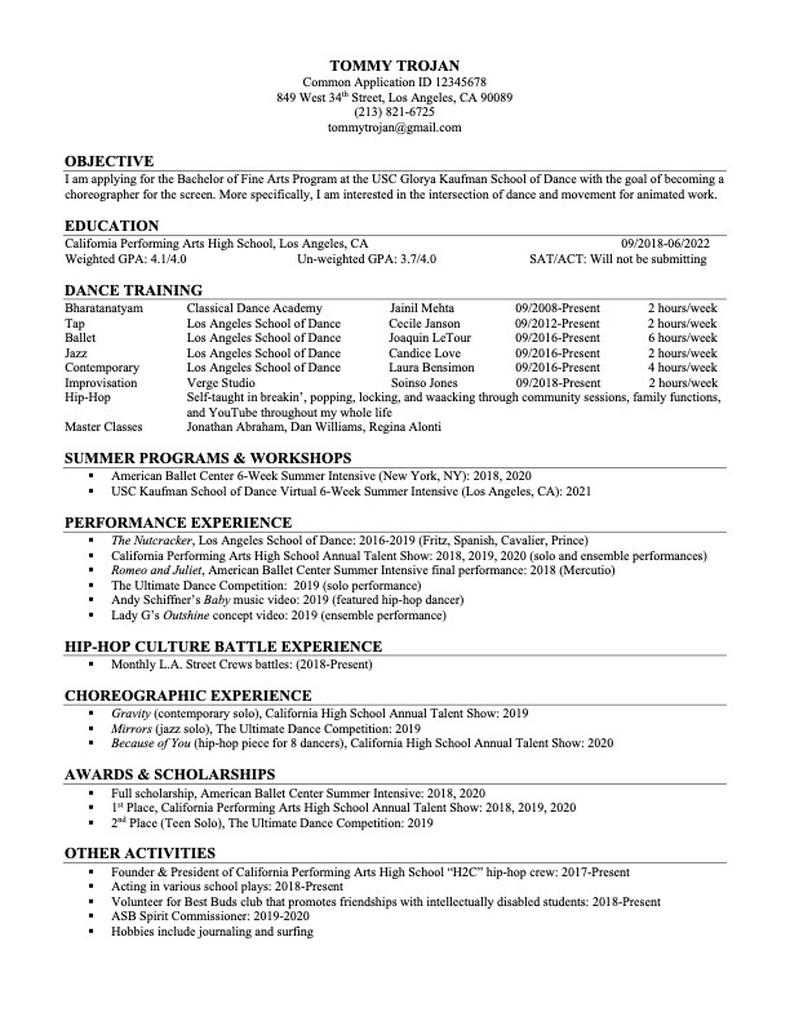
It includes key information at the top and a short introduction. Since dancers applying for (or in) training may have fewer performance credits, this CV is more weighted toward dance experience in education.
1. A traditional-style CV: Stephanie Troyak
Here is a link to a CV for dancer, choreographer, actor, and teacher Stephanie Troyak. It includes her name and headshot clearly at the top, followed by her experience, training, and references.
2. A web CV: Stefania Pinato
Dance artist, performer, and movement director Stefania Pinato has shared her CV on her website. It is very clear and straightforward, listing her credits by year with the name of the show, the choreographer, and where it was performed.
The CV then lists her education, awards, and teaching experience. Because this is an online CV, it looks slightly different from a CV you may attach as a document to an email. Pinato’s contact and other biographical information is clearly linked at the top of the page rather than appearing on the CV itself.
It’s perfectly understandable not to have many credits on your CV if you’re just starting out. Portus recalls that there was “quite a lot of space on the page” soon after she graduated. “I remember I had advice from older dancers to put any performance experience you have, even if it’s [from] when you’re a student,” she says.
Dance is a profession that requires rigorous training, and those credits you accumulated as a student are all great signals to casting directors.
It’s also worth asking more experienced dancers if you can take a look at their CVs as examples, she says.
At the start, Portus says, she would also list any intensive training workshops she had done. “When you’ve got fewer professional jobs that you can put down, it still shows what you’re interested in and what skills you have been developing, and it also shows that you’re keen and that you’ve taken the initiative to go and develop your practice.”