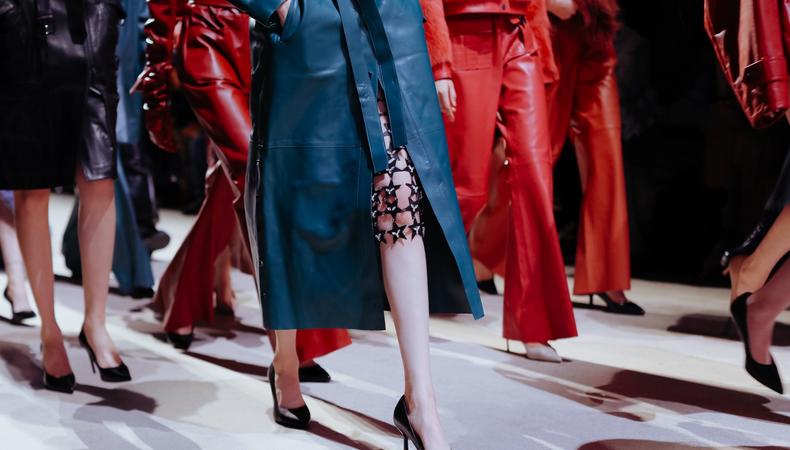
You know how to walk, but do you know how to walk the runway? If you want to become a fashion model, your catwalk strut is a foundational skill. Many models who have been the faces of top fashion brands started out in their Fashion Week shows, such as Anna Ewers for Balenciaga and Kendall Jenner for Marc Jacobs.
The key is learning the fundamentals first. “Of course, it’s about the walk, but I would almost say 75% is confidence,” runway coach Mandy Lieveld told Models.com.
Want to follow in their footsteps? Here’s what to know.
A catwalk walk, also known as a model walk or runway walk, is how a model moves when presenting clothing in a fashion show. Its purpose is to showcase the designer’s collection, allowing the audience to see how garments look, fit, and move on a real person.
Unlike everyday walking, a runway walk is a performance. Posture, stride, pace, facial expression, and body language all create the overall impression. A model needs to know how to catwalk while looking comfortable and confident – and making the clothes look their best.
There is an industry style, but you’ll find variation among designers. One may want a sharp, powerful stride to complement structured tailoring, while another prefers relaxed, natural movement to suit a more casual collection.
Before working on your own signature model walk, get to grips with these essential catwalk tips.
Posture
Keep your back straight, chest open, and shoulders slightly back, without forcing them into an exaggerated position. Your chin should remain level or very slightly lowered, with your gaze directed ahead rather than toward your feet.
Avoid hunching, leaning backward, or allowing your shoulders to rise toward your ears. The aim is to look tall and relaxed, not rigid. A Royal Academy of Dance catwalk workshop used a broomstick held between the elbows to help participants learn how to walk like a model.
Foot placement
A runway stride is generally longer and more deliberate than an everyday step. Place one foot in front of the other to create a relatively straight line. Your toes should point forward, and your steps should feel controlled rather than hurried.
Your hips will move naturally as you walk, creating a sway that can be dialled up or down depending on a designer’s brief.
Arms and hands
Hang your arms by your sides, allowing a small, natural swing as you move. Your hands should remain relaxed, rather than clenched into fists.
The same Royal Academy of Dance workshop used a small handbag held lightly by its handle to help trainees establish a controlled arm movement.
Pacing
Your pace should be consistent. Listen to the music and use it as a guide, but don’t assume you must match every beat.
Pacing can be hard to gauge at a model casting. Just do what you are most comfortable with. Then be willing if the casting director asks you to walk again with a specific direction.
Facial expression
A classic runway expression is often neutral and relaxed. Some designers, however, want playful expressions, smiles, or a more theatrical performance.
Keep your gaze focused ahead, choosing a point in the distance rather than looking down at the floor or making prolonged eye contact with individual audience members.
The turn and pose
At the end of the runway, slow down as you approach your designated stopping point. Pause, place your weight securely, and strike a pose that allows the outfit to be seen. Hold it briefly before turning smoothly and walking back.
Practise your turn until it feels natural. Avoid rushing, spinning, or making unnecessary movements. Your pose should complement the clothes, whether that means showing off a dramatic silhouette, a jacket, or an interesting detail.
1. Set up your runway
Find a clear, straight stretch of floor, ideally with a full-length mirror at one end. Use masking tape to mark a straight line along the floor, creating a visual guide for your foot placement. Naomi Campbell’s catwalk tips include putting on a song that energises you.
2. Start with posture
Walk the length of your practice runway several times, concentrating on keeping your head up, shoulders relaxed, and back straight. Don’t worry about speed initially. Once your posture feels comfortable, introduce a longer, faster stride.
3. Practise in heels
Practise walking in heels every day. Start with a manageable heel height and build up as your balance improves. Focus on walking smoothly without wobbling, gripping your toes, or looking down. You should be able to stop and turn confidently too.
4. Relax your arms
Try the handbag exercise from the Royal Academy of Dance workshop, holding a small bag lightly by its handle as you practise your catwalk walk. Once you’ve established a natural arm swing, repeat the exercise without the bag.
5. Film yourself
Recording your walk is one of the most useful ways to identify areas for improvement for how to walk the runway. Lieveld uses before-and-after videos in her coaching sessions to help models see how their posture, expression, arm movements, and confidence develop.
6. Try different catwalk walks
Once you’ve established the basics, experiment with different model walks. Try a strong, energetic stride, followed by something more understated and natural. Watch footage of different Fashion Week shows to see how different designers use the models’ movement to communicate the mood of a collection.