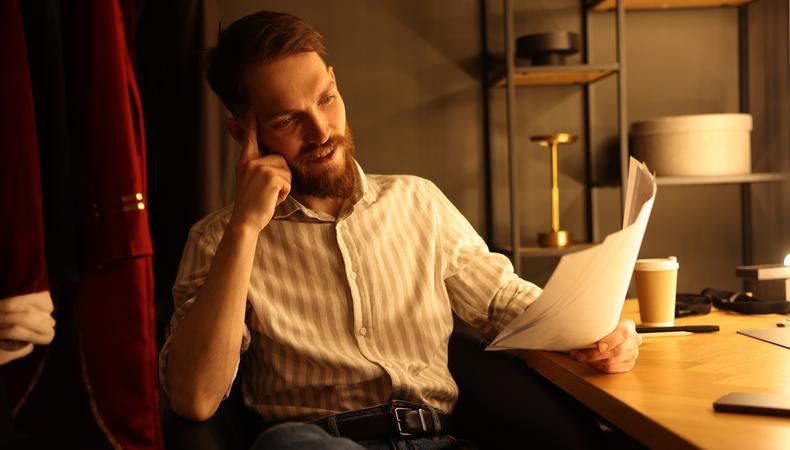
Close your eyes and think about the house you grew up in. What did it smell like? Was the wallpaper bumpy? What sounds would you hear as you walked through the door? When you think of those senses, do they have feelings attached?
To access those senses and the feelings they’re swept up in, you’re using both sense memory and affected memory. They’re essential tools for helping actors draw on personal experiences to build an authentic, emotional response in their performances, onstage or in auditions.
The techniques are part of Konstantin Stanislavsky’s legacy. “Stanislavsky provided a route map,” former chief theatre critic Michael Billington wrote in the Guardian, “for exploring what he called ‘that conscious road to the gates of the unconscious,’ which is the foundation of modern theatre. And it is a map that no actor, even today, can afford to ignore.”
JUMP TO
Sense memory is the recall of an experience of sight, sound, smell, touch, or taste to evoke a response with appropriate emotion in a scene. Codified by Lee Strasberg, who built on Stanislavsky’s work, sense memory is used to bring a particular sensation closer for an actor.
Our life is filtered through our senses. We experience our days through the seats we sit on, the rain we walk through, the smell of the alleyways we pass. These are kept tucked away in our subconscious, but mastering sense memory – where you can conjure the sensual experience on cue – can help them resurface.
Key principles of sense memory include total physical relaxation, absolute concentration on small details, and gradual conditioning through regular practice. The ambition is to train the body to get into a particularly receptive state at will during a performance.
“It’s a detail-oriented process of deciphering human behaviour in order to truly embody how we function, rather than merely imitating life,” David Barrouk writes in Stanislavski and The Method for the 21st Century Actor: A Practical Guide.
Affective memory, also called emotional recall, is a technique in which an actor consciously remembers a past experience to create genuine emotions they need for a scene. It was developed as part of Stanislavsky’s work, and Strasberg later popularised it as a central philosophy of method acting, alongside sense memory, with the aim of achieving psychological realism onstage.
“This technique asks us to forget about ‘acting’ out emotions,” acting coach Brian Timoney writes. “Feeling emotion is such a visceral part of the human experience that it is at the same time universal and difficult to fake. Because it’s universal, though, you don’t have to fake it – just remember it.”
Based in psychology, the key principles of affective memory include deep mental focus, substitution of personal memories for the emotional life of the character, and the efficient filing of memories. The technique means an actor can bring a personal, relevant emotional response to a situation their character is facing. That act of emotional recall is not just remembering but reliving, enabling an actor to create a believable life for the part they’re playing.
Credit: New Africa/Shutterstock
Sense memory, which focuses on particular sensations, is different from affective memory, which emphasises the feelings attached to past experiences. Many actors use one technique to lead to the other. Often, affective memory uses the sensations conjured by sense memory to tap into deeper emotional states for a character.
The acting coach Joan Stephens told Backstage about supporting a young actress through a scene of bitterness between two friends, using both sense memory and affective memory to do so. The pair worked to find an experience with similar emotions in the actress’s own life. “She found that a piece of music playing during the remembered event and the feel of the rain that was falling were powerful stimuli,” Stephens says. “After some practice, she was able to quickly and consistently tap into these sense memories to inspire the appropriate emotions.”
Regular exercises can help you train your mind and body to relive physical sensations from your past experiences at will. With practise, you can tap into past sensations that can help you get into your character more truthfully and present their life more faithfully. Strasberg suggested that actors should practise relaxation and sense memory exercises for 15 minutes in the morning and 15 minutes at night.
Learn total relaxation
To engage in sense memory, you need to be able to control your emotional state. That means being able to control your imagination and know when to step in and out of the emotion. Try sitting in a chair and loosening every part of your body. With every in-breath, focus on a different body part, working your way up from your feet to your head. With every out-breath, relax that area of your body. You’re aiming for total relaxation. Pay attention to your body and which parts feel particularly hard to relax.
Practise with your morning coffee
Practise this exercise when you have a cup of tea or coffee. Hold the real cup and think about what sensations you feel. Work through each of the senses. Memorise how steam rises from it, or what shape your hands make around it. Think about how heavy it is or what it sounds like as you put it down.
Now put the cup down and try to conjure the same sensations. You don’t need to do the same movements, just try to bring the feeling of the heat or the bitterness or the weight of the cup into the foreground of your mind and body.
1. Start with everyday sensations: Ease yourself into it. Start with small, simple things and build your way up.
2. Build boundaries: Psychological safety is important. Put in place your own boundaries or “no-go” areas that you’re not comfortable trying to access through these techniques.
3. End the session well: Create a routine for finishing your exercises and resettling back into your life. That may mean changing your clothes or shaking your body to disconnect from the experience.