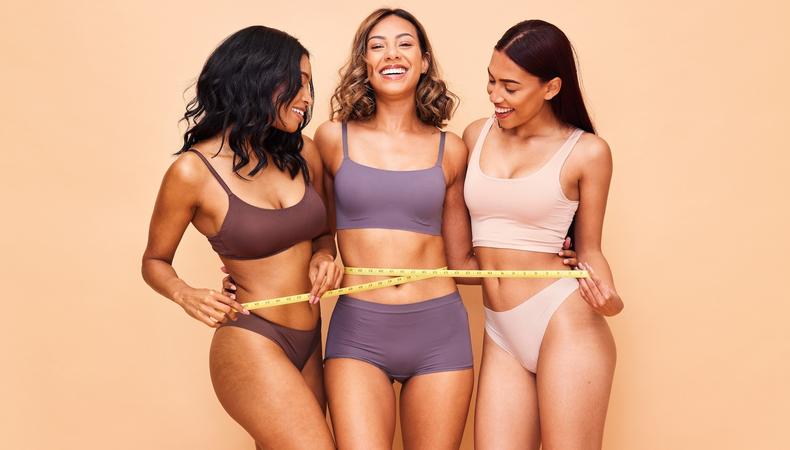
From catwalk to curve, model measurements – like models – come in all shapes and sizes. But the subject is made all the more confusing when stories about the industry’s stringent size restrictions are regularly featured in the media.
The answer to “what are the ideal measurements for a model” isn’t so clear-cut. The UK industry runs on several different rulebooks depending on the modelling niche.
If you really want to know what models’ measurements are, you have to specify which type of modelling. From fashion editorial and commercial to fitness and plus-size, each niche has its own norms.
If you’re hoping to become a model, you’ll want to know where you fit in.
JUMP TO
Model measurements for fashion models (the most common type of modelling) are generally tied to the industry standard for sample sizes, which is typically a UK 6 to 8 for women.
Clients need to know a model can fit a sample garment or shoe, so that’s why some of the sizing for models is so specific.
Below we outline the average model measurements, showing where opportunities concentrate within each niche. If your sizes are different, though, it doesn’t mean you won’t have success. Other factors are always at play, such as your look, your on-camera charisma, and whether you have stand-out body parts such as hands, hair, or eyes and could therefore be a successful parts model.
Credit: ViDI Studio/Shutterstock
There is no “best” body shape in modelling. There’s simply the best shape for each corner of the industry, and high fashion remains the most restrictive type of modelling.
Editorial and catwalk clients typically build garments around one sample size, so a model’s shape may genuinely limit which castings they’re right for, no matter how striking they look in person.
Fortunately, the modelling industry is vast and increasingly diverse. There is still a lot of demand for traditionally tall, slim figures, but other body shapes and model measurements are giving them competition.
Fuller figures are great for the fast-growing plus-size sector. Smaller frames suit petite specialists. Muscular builds will succeed in the fitness sector. And parts modelling can sit entirely outside the usual height and shape requirements altogether. Commercial models, meanwhile, typically need to reflect a company’s customer base, so that pocket of the industry is less restrictive when it comes to size.
Examine your existing proportions and identify which niche you already suit. Build your portfolio around your natural strengths to land yourself an agent who will support you for who you are.
Top agents and talent managers consistently say that personality and work ethic count for as much as – and sometimes more than – a model’s measurements.
The following are general guides drawn from UK agency standards and casting norms, not rigid cut-offs. The requirements for client briefs and open casting calls vary, and most agencies (including major London institutions such as Storm, Select, and Premier) will consider a model who is truly distinctive, even outside these ranges.
1. Fashion modelling
Website UK Models outlines fashion model measurements for women as between 5 feet, 8 inches and 5 feet, 11 inches, with a dress size of 6 to 8 and a 34-24-34 bust, waist, and hip measurement. Male fashion models are typically expected to be between about 6-foot-1 and 6-foot-3.
For high-fashion runway modelling, female models are expected to be UK size 4 to 8. The industry favours a slim, tall build with measurements all in proportion.
That’s because of strict industry sample sizes. Designers cut one-off runway pieces to a single set of measurements, so models are cast to fit the garment. There is the least flexibility in this niche, but London has grown more open to diverse body sizes than Paris and Milan.
2. Petite modelling
A petite model is classed as between 5-foot-2 and 5-foot-6, according to UK Models, because average model height is so much taller than the non-model average. Like fashion models, those in the petite sector are also expected to have their measurements in proportion to their height, with a slim build generally preferred.
3. Commercial modelling
Height guidance for commercial modelling sits around 5-foot-6 to 5-foot-11 for women and 5-foot-9 to 6-foot-2 for men. Agencies such as The Diversity Agency, however, are clear that height and precise measurements matter far less than an approachable, relatable look. As a result, there is often an overlap between commercial casting and what’s known as “real life” casting.
Commercial modelling spans catalogues, adverts, lifestyle, and product photography. Clients want models who reflect their real customers, so older models and a wide range of body types and ethnic backgrounds can find consistent work.
4. Plus-size modelling
One of the fastest-growing sectors in fashion, plus-size modelling generally refers to model measurements of UK size 12 to 18 or above. Height still matters at the top end: High-fashion plus-size campaigns often favour models who are 5-foot-8 to 6-foot, while commercial plus-size work opens up to those around 5-foot-6. This niche is built explicitly around body diversity, and its growth has expanded opportunities: Most modelling agencies now sport a dedicated curve division.
5. Lingerie modelling
According to The Diversity Agency, underwear and lingerie clients generally look for female models between 5-foot-4 and 5-foot-9 with a dress size of UK 8 to 10, with balanced proportions and a toned physique. This niche sits closer to fashion’s standards than commercial’s, although there’s a growing appetite for a broader range of shapes.
6. Foot modelling
Foot and leg modelling is a specialised parts category with no height requirement and no upper age limit. Shoe size is critical, however, since footwear and hosiery clients typically shoot to a single sample size.
“For regular e-commerce work, female models in UK size 7 or 4 and male models in UK size 8 are most consistently castable, as these align with the standard sample sizes used by footwear brands,” according to Hired Hands Models.
Beyond size, you also need smooth, even-toned skin; healthy nails; and no visible veins or blemishes.
7. Fitness modelling
Fitness modelling prioritises physique over height and precise model measurements. Clients often require a lean, athletic build and a genuine ability to demonstrate activewear or equipment convincingly, so specialising in a particular sport can be as valuable as any measurement.
According to The Mother Agents, female fitness models need to aim for 15% to 17% body fat with measurements of approximately a 34-inch bust, 26-inch waist, and 36-inch hips. Men should have 6% to 7% body fat with a roughly 38- to 40-inch chest and a 32- to 34-inch waist.