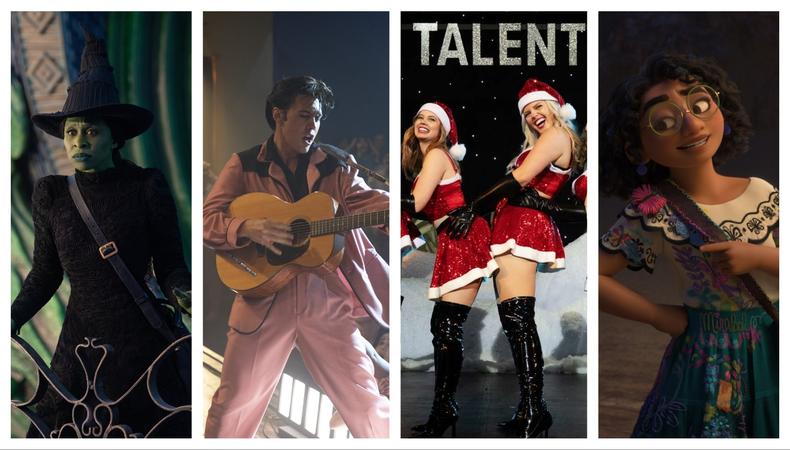
Whether you love them or can’t stand them, it’s hard to argue with the fact that some of the most memorable and beloved moments of cinematic history come from musicals. Whether it’s Julie Andrews belting that the hills are alive against a backdrop of breathtaking Austrian mountains, Gene Kelly joyously singing and tap dancing his way through a downpour, or Olivia Newton-John uttering the iconic “Tell me about it, stud,” you probably know the scenes we’re talking about.
Musicals have the ability to transport audiences into larger-than-life worlds in which song and dance play a central role in storytelling, and whether it’s musical theatre or a musical film, they carry common characteristics, conventions, and tropes. If you’re looking to understand the genre better, this guide has you covered.
JUMP TO
The musical genre is a distinct category of film, television, and theatre in which a story is told not just through dialogue and dramatic action, but also through music, song, and dance.
In musicals, characters will break into song and dance as a way to express their inner world, giving audiences a more vivid sense of their emotions, thoughts, and feelings.
The first “talkie” ever made was The Jazz Singer, which premiered in 1927. It was also the first musical film ever made. Within a decade, movie musicals had become one of Hollywood’s most popular genres, featuring elaborate sets, jaw-dropping dance routines, memorable songs, and star performances. They offered audiences exuberant escapism from the Great Depression and war, particularly when they transitioned from black and white to “glorious Technicolor.”
By the 1960s and ’70s, a Broadway-to-Hollywood pipeline had formed, and stage hits such as The Sound of Music, My Fair Lady, and Grease became blockbuster films. Despite a decline in the production of movie musicals since then, that stage-to-screen formula has persisted, delivering edgier hits such as the Oscar-winning Chicago, gothics such as Sweeney Todd: The Demon Barber of Fleet Street, and fantastical stories such as Wicked, which overtook Mamma Mia! as the highest-grossing Broadway adaptation in global box-office history.
Golden Age musicals
Lavish productions full of showstopping numbers, dreamy dance sequences, and happy endings were key to the iconic Golden Age musicals – released between the late 1930s and 1959 – and the escapism they offered. Prime examples of the subgenre include Swing Time (1936), The Wizard of Oz (1939), An American in Paris (1951), Singin’ in the Rain (1952), and My Fair Lady (1964).
Book musicals
This type of musical combines an original script (or book) with original music and lyrics (or score, as it’s also known). Not particular to any era – a lot of Golden Age musicals are also book musicals, for instance – the songs and music in this subgenre are integral to developing characters and moving the narrative forward. Many of the most famous examples began as stage productions on Broadway before being successfully adapted for the big screen: West Side Story (1961 and 2021), My Fair Lady (1964), The Sound of Music (1965), The Color Purple (1985), The Phantom of the Opera (2004), and Les Misérables (2012).
Jukebox musicals
These musicals take preexisting songs, usually from a specific artist, band, or era, and create an original narrative around that borrowed score, allowing audiences to experience well-known music in a new light. Mamma Mia! (2008), Mamma Mia! Here We Go Again (2018), Jersey Boys (2014), and Glee (2009–15) are probably the most famous onscreen jukebox musicals.
Musical biopics
Although they’re similar to jukebox musicals in that they use the preexisting songs of an artist or band, a musical biopic focuses on telling the autobiographical story of those artists or bands. They generally don’t follow the usual tropes and conventions of musicals, and the jury is still out on whether they really count as musicals. Prime examples include The Buddy Holly Story (1978), Walk the Line (2005), Rocketman (2019), Whitney Houston: I Wanna Dance With Somebody (2022), Elvis (2022), and A Complete Unknown (2024).
Rock musicals
This subgenre incorporates elements of rock music into its songs, fusing many of the traditional conventions of musicals with the energetic, rebellious spirit of rock. The style also bleeds into the thematic content of the story, creating a far edgier type of musical than those of the Golden Age. Musicals such as Tommy (1975), The Rocky Horror Picture Show (1975), Grease (1978), The Little Shop of Horrors (1986), and Rent (2005) are all excellent examples of the rock musical subgenre.
Pop musicals
Combining the conventions of traditional musicals with more contemporary pop music, this subgenre has mainstream appeal due to catchy songs that reflect the contemporary, chart-topping music of the time in which they are made, such as The Greatest Showman (2017) and Mean Girls (2024), or the time in which they are set, such as Dreamgirls (2006) and Hairspray (2007).
Animated musicals
Heartwarming and child-friendly adventures and love stories from Disney – such as The Jungle Book (1967), The Lion King (1994), Tangled (2010), Frozen (2013), Moana (2016), and Encanto (2021) – tend to dominate the animated musical subgenre, but other darker and more adult versions, such as Corpse Bride (2005) and South Park: Bigger, Longer and Uncut (1999), have also had their moment.
It’s important to note that many of these examples could fit into more than one subgenre: Mamma Mia! could be considered a pop musical and a jukebox musical, Tommy is a jukebox musical that’s also a rock musical, and Encanto is an animated musical that is arguably also a book musical. These musicals can all also be categorised under different movie genres and subgenres, such as comedy, romance, fantasy, or period drama.
From Golden Age classics such as An American in Paris and Singin’ in the Rain to modern hits such as Wicked and La La Land, there are certain tropes and conventions audiences can expect from a musical.
1. An opening number that grabs the audience and introduces the tone, setting, and main characters. Think “No One Mourns the Wicked” from, you guessed it, Wicked; “All That Jazz” from Chicago; and “Good Morning Baltimore” from Hairspray.
2. A showstopper is a number that creates a moment of spine-tingling transcendence – a big song that stops audiences in their tracks and sticks in their minds long after watching. It could be a powerfully rousing anthem, such as “Defying Gravity” from Wicked, or an ecstatically vibrant moment when story, music, and dance collide, such as “America” from West Side Story.
3. A fantasy sequence that transports the characters to an imaginary dream world, either through song, dance, or both. An American in Paris features one of the most famous fantasy sequences of all time: a 17-minute ballet sequence danced by the film’s leads, Gene Kelly and Leslie Caron, which inspired Damien Chazelle in the making of La La Land.
4. Dance numbers are staples in many musicals. They may be used when words aren’t enough to convey the sheer joy or depth of emotion a character feels (such as the Gene Kelly, Debbie Reynolds, and Donald O’Connor dance break in “Good Morning” from Singin’ in the Rain) or as means to reengage the audience in the latter half of a musical film (such as “Step in Time” from Mary Poppins).
5. Leitmotifs and reprises are classic tools of musical theatre that are frequently used in musical films and TV shows. They are recurrent musical themes, or a short reprise from a previous song, which help to establish character or the tone of a scene, highlight turning points in a character’s arc, or emphasise a shift in tone. Rachel Bloom used them to great effect over the four seasons of her musical TV show Crazy Ex-Girlfriend. “Reprises especially help us connect the thematic dots between situations and characters,” Bloom told New Musical Theatre. “It’s really gratifying to take a song from Season 1 and reprise it in Season 3.”
6. Familiar character archetypes are a staple of musical theatre. Using common character archetypes such as the hero, love interest, mentor, and villain make them familiar to audiences, allowing them to quickly relate to the story and tap into its universal themes and human emotions.
7. Characters breaking into song may seem an obvious one, but characters doing so in the midst of their everyday lives is an integral part of every musical. And that doesn’t mean they’re picking up a mic and performing. In musicals, characters break into song when they are no longer physically able to contain their emotions in speech alone, and it’s a necessary convention of the musical genre.
8. The big finale is a number that acts like a bow on the wrapping of the plot. It usually brings together key characters, and it often reprises an important song. In Chicago, for example, musical motifs from the opening song, “All That Jazz,” form part of the big finale number “Nowadays/Hot Honey Rag,” highlighting the journey its protagonists, Roxie Hart and Velma Kelly, have been on.