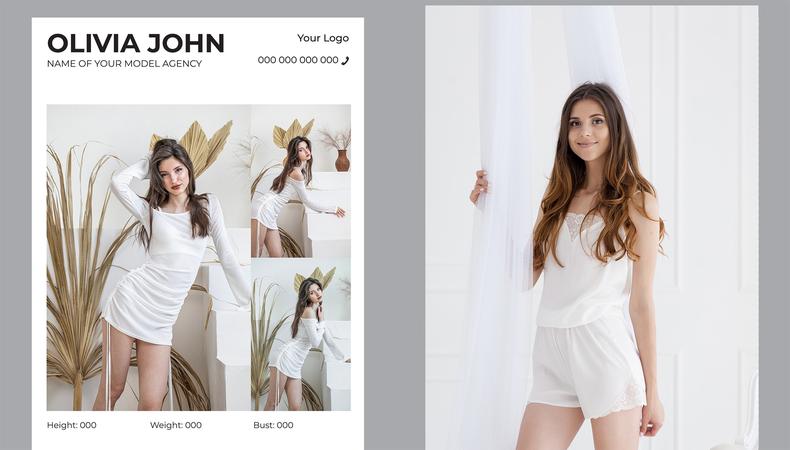
Modelling is all about presence, attitude, and chemistry. How you behave in the room is essential to modelling, but it can be helpful to leave behind a little reminder of yourself to prevent casting directors forgetting you. That’s where your model comp card comes in.
Read on to find out what a comp card is, how big your model comp card should be, and how to ensure that yours sits at the top of the pile.
JUMP TO
A model comp card (or composite card) is like a business card specifically for models. The main differences are size (comp cards are usually A5) and details; as well as contact information, a model comp card includes your key measurements.
According to modelling agency Elite, comp cards are kept on a wall or board at the agency and given to clients at castings.
Your comp card needs to be about A5 in size and a decent thickness so it doesn’t get bent out of shape easily. Roughly 300 to 350 gsm is a good place to start.
Your composite card should have high-resolution, good-quality photos, since blurred or pixelated images signal unprofessionalism. You’ll need a hero image, supporting images, and your key measurements.
If you look at any modelling agency’s website, the hero images of each model in their directory will usually correspond to the main photo on their model comp card. Consider it the photo that sums up your look and attitude.
It’s crucial that your current look is reflected in this image. It’s no use using a photo of you with hair extensions when you actually wear it short. If you decide you want a new haircut, you’ll have to update your comp card!
Castings can be busy and hectic. You may only have a minute or two to make an impression, so it’s important to have a professional model comp card with a knockout image and clean and clear design.
Most model comp cards are A5. The main thing is that it’s big enough to contain all of your measurements and contact details, as well as show at least one stunning and clear shot of your face.
If you make it closer to the size of a business card, it will likely get lost – especially during a period like Fashion Week, when a casting director may see hundreds of models in a day.
You could make it bigger, but people may not realise it’s a comp card if it looks too different from what everyone else has. It’s safest to stick with industry standards.
1. Identify your modelling niche.
Start by identifying the types of modelling you want to pursue. A fashion-focused model comp card may emphasise proportions, poses, and a strong editorial image, while commercial work may benefit from approachable expressions and a more everyday look.
Don’t try to present yourself as suitable for every possible client; that’s an impossible task! Stay true to your strongest looks and what you enjoy most.
2. Choose your main image.
Your lead image should make your face and overall appearance easy to assess. A clear headshot with natural-looking lighting is a reliable starting point.
Choose a photograph that resembles how you look in person. It doesn’t have to be dramatic or heavily styled. A straightforward image that communicates your look clearly can be more useful than an elaborate photograph that obscures it.
3. Select supporting images.
Choose two or three additional images that demonstrate different aspects of your look. Include a full-length photograph and consider varying your expression, styling, pose, and clothing.
Each image should add something new. Five nearly identical headshots won’t tell a casting director much more than one, but a considered selection can show how you might work across different briefs.
If you’re new to modelling, you may not need an expensive shoot straight away. Start with suitable, clear photographs and build your selection as you gain experience.
4. Take accurate measurements.
Measure yourself carefully and record your details in both metric (cm) and imperial (inches) units. Keep your measurements up to date.
Depending on your modelling niche, relevant details may include height, bust or chest, waist, hips, dress or clothing size, and shoe size. Not every category requires every measurement, so tailor the information to the work you’re pursuing. If you’re an aspiring hand model, for example, you’ll want to include glove size.
Never guess or alter your measurements to match a brief. Accurate information helps agencies and clients determine whether you’re suitable for a booking.
5. Lay it out clearly.
Use a design tool or template to arrange your main image, supporting photographs, and details. Keep the hierarchy simple: photographs first, essential information second.
Check that your name, measurements, and contact details are easy to locate. Make sure the photographs are large enough to assess and the text doesn’t overlap important parts of the images.
6. Check, check, and check again.
Review your model comp card as if you were a casting director seeing it for the first time. Could they quickly identify you on the page, assess your look, and find your measurements?
Check spelling, image quality, consistency, and contact details. Make sure your composite card reflects your current appearance, and remove any photographs that are heavily edited, outdated, or noticeably different from the others. Ask someone you trust to review the layout before you send it out. Mistakes make you look unprofessional and could even prevent you from getting hired.
7. Export, save, and print.
Print your comp card. Save a print-ready version in case you need to print more copies and a digital version in the format requested by agencies or clients. Keep the original design editable so you can update photographs, measurements, and contact details as your career develops.
8. Keep your model comp card updated.
Your comp card should evolve with your modelling experience. Replace older images when you have stronger, more representative work, and check your details regularly. A focused, accurate model comp card is more useful than one filled with photographs simply to make it look impressive.